Showing posts with label 'The Slum'. Show all posts

Friday, 26 April 2013

Public Lecture by Ananya Roy in Johannesburg: Making Slum-Free Cities: Global Urbanism in the Asian Century

The School of Architecture and Planning at the University of the Witwatersrand, invites you to attend the 2013 Rusty Bernstein Memorial Lecture.

Making Slum-Free Cities: Global Urbanism in the Asian Century

Delivered by Ananya Roy, Professor of City and Regional Planning and Distinguished Chair in Global Poverty and Practice at the University of California, Berkeley.

Date: 16 May 2013
Time: 17h30 for 18h00 to 20h30
Venue: Dorothy Susskind Auditorium, John Moffat Building, East Campus,
University of the Witwatersrand

Monday, 19 November 2012

Lindela Figlan Speaking in Edinburgh

A fantastic talk by Lindela Figlan, spokesperson from Abahlali baseMjondolo, the shackdwellers' movement of South Africa. In Edinburgh October 2012, co-hosted by Edinburgh Coalition Against Poverty (ECAP) and Edinburgh Anarchist Federation.

Saturday, 27 October 2012

Slum politics: Community leaders, everyday needs, and utopian aspirations in Recife, Brazil

by Martijn Koster and Pieter A. de Vries

This article envisages slum dwellers’ politics in Recife, Brazil as a realm of possibility in which care and recognition are central. Community leaders are its main facilitators as articulators of slum dwellers’ needs and aspirations. The article’s notion of slum politics is an elaboration of Chatterjee’s (2004) ideas on popular politics as a “politics of the governed.” Yet the article critiques the governmentality perspective for its inability to envisage a politics of hope and possibility. It distinguishes among slum politics, governmental politics (projects and programs), and electoral politics (voting), which are entwined and interdependent, but different. Zooming in on a community leader’s urban agriculture project, the article argues that this project, which from an outsiders’ perspective may be considered non-viable, provided slum dwellers with possibilities to strive for community solidarity and personal recognition. Slum politics, the article concludes, is about claiming the right to be counted and recognized, and about the care for the other.

Friday, 17 February 2012

We Want the Full Loaf (not just a child support grant)

Presentation at the Development Action Group Workshop
Cape Town, 18 November 2009

by Mnikelo Ndabankulu, Abahlali baseMjondolo

We Want the Full Loaf (not just a child support grant)

The Slums Act

The Slums Act first came to our ears as a Bill in 2006. The information about this Bill came to us indirectly through our sources.

It was clear that we needed to discuss this Bill as Abahlali. M'du Hlongwa and I both went to the Government Communications to ask a copy. We had two copies and we shared these copies and we analysed the Bill. We had a number of meetings where we read the Bill together going one line by one line.

Tuesday, 1 November 2011

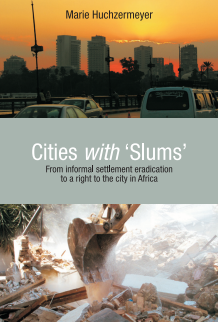
Cities with ‘Slums’: From Informal Settlement Eradication to a Right To The City In Africa

Cities with 'Slums'
Cities with Slums
by Marie Huchzermeyer, 2011

The UN’s Development target to improve the lives of 100 million ‘slum’ dwellers has been inappropriately communicated as a target to free cities of slums. Cities with ‘Slums’: From Informal Settlement Eradication to a Right To The City In Africa traces the proliferation of this misunderstanding across several African countries, and explains how current urban policy, with its heightened focus on urban competitiveness and associated urban policy norms, encourages this interpretation.

Sunday, 14 August 2011

Apocalyptic anti-urbanism: Mike Davis and his planet of slums

by Tom Angotti, 2006

The title of Mike Davis’ latest tome should make every progressive cringe. Boston’s Mel King, prominent African-American community activist, once said that for him the term slum meant that ‘somebody else defined my community in a way that allowed them to justify destruction of it’. Slum clearance was the high-minded objective of the federal urban renewal program in the US, the program that displaced millions of people, disproportionately poor and African-American. Around the world today, working people are evicted by governments and private developers who have determined that their neighborhoods are hopeless ‘slums’ filled with disease, crime, and unemployment, problems which they claim will go away once the people are out of sight and cities stop growing. While ‘slum’ is used in other parts of the world without the negative connotation it enjoys in the US, such homogenizing labels continue to obscure both the underlying relations of social and political inequality and an increasingly complex urban world.

Saturday, 9 July 2011

The Return of the Slum: Does Language Matter?

by Alan Gilbert, 2007

The ‘cities without slums’ initiative has resuscitated an old and dangerous term from the habitat vocabulary. Use of the word ‘slum’ will recreate many of the myths about poor people that years of careful research have discredited. The UN has employed the word in order to publicize the seriousness of urban problems and to improve its ability to attract funding with which to tackle the issue. But in using such an emotive word the UN risks opening a Pandora’s box. The campaign implies that cities can actually rid themselves of slums, an idea that is wholly unachievable. The word is also dangerous because it confuses the physical problem of poor quality housing with the characteristics of the people living there. The UN knows that earlier research has rehabilitated most ‘slum dwellers’ but ignores the danger of conjuring up all of the old images. In the process, the campaign also offers an oblique invitation to governments to look for instant solutions to insoluble problems. Demagogic governments have always shown a willingness to demolish slums despite the fact that experience has shown that policy to be ineffective. I fear that the new campaign will encourage more to employ this foolish policy. Words need to be employed carefully.