Marxism Modernity and Post Colonial Studies Cultural Margins by Adie Marzuki
Showing posts with label Neil Lazarus. Show all posts
Showing posts with label Neil Lazarus. Show all posts
Wednesday, 15 May 2013
Wednesday, 24 April 2013
The fetish of “the West” in postcolonial theory
by Neil Lazarus, 2004
In a commentary entitled “East isn’t East,” which appeared
not long
ago in the Times Literary Supplement, Edward Said proposed
that one
of the essential gestures of postcolonial criticism, and one
of its enduring
achievements, rested in what he called its “consistent
critique
of Eurocentrism” (1995: 5). In the pages that follow, I
would like to
put some pressure on this assessment. My intention is not,
of course,
to suggest that the postcolonialist critique of Eurocentrism
has not
been significant in helping to expose the tendentiousness,
chauvinism,
and sheer pervasiveness of the ideological formation that
Said
himself, in his seminal study of 1978, addressed under the
rubric of
Orientalism. I take it for granted that it has, and believe
moreover that
to argue otherwise would be simply perverse. Rather, my aim
in this
chapter is to suggest that in the field of postcolonial
studies at large,
including in the work of some of the field’s most audacious
and theoretically
sophisticated practitioners, Eurocentrism has typically been
viewed not as an ideology or mode of representation but as
itself the
very basis of domination in the colonial and modern imperial
contexts.


Thursday, 17 May 2012
Nationalism and Cultural Practice in the Postcolonial World
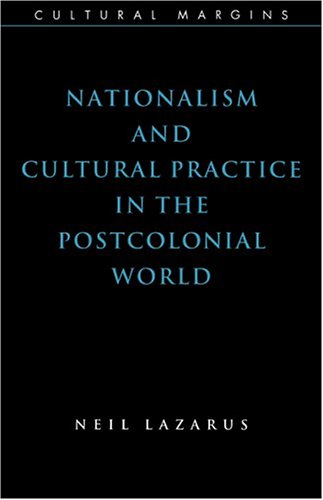
by Neil Lazarus, 1999
This
wide-ranging study contains individual chapers on modernity,
globalization and the "West," nationalism and
decolonization, cricket and popular consciousness in the
English-speaking Caribbean, and African pop music. Neil Lazarus
offers extended discussions of the work of such influential writers,
critics and activists as Frantz Fanon, C. L. R. James, Edward Said,
Gayatri Spivak, Samir Amin, Raymond Williams, Paul Gilroy and Partha
Chatterjee. This book is a politically focused, materialist
intervention into postcolonial and cultural studies, and constitutes
a major reappraisal of the debates on politics and culture in these
fields.
Monday, 9 April 2012
The Postcolonial Unconsciousness
 |
| The Postcolonial Unconsciousness |
The Postcolonial Unconscious is a major attempt to reconstruct the whole field of postcolonial studies. In this magisterial and, at times, polemical study, Neil Lazarus argues that the key critical concepts that form the very foundation of the field need to be re-assessed and questioned. Drawing on a vast range of literary sources, Lazarus investigates works and authors from Latin America and the Caribbean, Africa and the Arab world, South, Southeast and East Asia, to reconsider them from a postcolonial perspective. Alongside this, he offers bold new readings of some of the most influential figures in the field: Fredric Jameson, Edward Said and Frantz Fanon.
Subscribe to:
Posts (Atom)