Showing posts with label Prison Intellectuals. Show all posts
Showing posts with label Prison Intellectuals. Show all posts
Thursday, 6 February 2014
Sunday, 3 February 2013
Thursday, 20 December 2012
Tuesday, 1 May 2012
The LA rebellion, 20 years later
by Nigel C. Gibson
Paper
presented at the conference on 'The LA Riots, Twenty Years Later',
Harvard, April 2012, Published at Truthout
1. Letter From a Friend
I asked a friend who lives in South Central to send me his thoughts about Los Angeles 20 years after the rebellion. The following is part of what he had to say:
Twenty years after the L.A. rebellion finds most of the Black community in a state of shock because conditions are not better and the conditions which created the rebellion have only become more invisible to the outside world. The strait jacket of economics confines us all. The rock bottom conditions of poverty are suffocating the voice of protest in South Central L.A. Even the name South Central was changed to South L.A. by the politicians in an attempt to forget in their view the "negative" impact of the revolt.


Sunday, 7 August 2011
Kalakuta Republic

Titled after a prison cell familiar to many of Nigeria's political prisoners and dissidents, Kalakuta Republic is a powerful collection of poems detailing the harrowing experiences endured by Abani and others at the hands of Nigeria's military regime in the late 1980s. In them he describes the characters that peopled his dark world, from the prison inmates to their torturers. While intense episodes are vividly described, it is above all a work greatly tinged with humanity and a durable tribute to the triumph of the human spirit.
Wednesday, 27 July 2011
Remembering the Real Dragon- An Interview with George Jackson May 16 and June 29, 1971
Interview by Karen Wald and published in Cages of Steel: The Politics Of Imprisonment In The United States (Edited by Ward Churchill and J.J. Vander Wall), History is a Weapon
Karen Wald: George, could you comment on your conception of revolution?
George Jackson: The principle contradiction between the oppressor and oppressed can be reduced to the fact that the only way the oppressor can maintain his position is by fostering, nurturing, building contempt for the oppressed. That thing gets out of hand after a while. It leads to excesses that we see and the excesses are growing within the totalitarian state here. The excesses breed resistance; resistance is growing. The thing grows in a spiral. It can only end one way. The excesses lead to resistance, resistance leads to brutality, the brutality leads to more resistance, and finally the question will be resolved with either the uneconomic destruction of the oppressed, or the end of oppression. These are the workings of revolution. It grows in spirals, confrontations, and I mean on all levels. The institutions of society have buttressed the establishment, so I mean all levels have to be assaulted.
Friday, 24 June 2011
Soledad Brother: The Prison Letters of George Jackson
The full text of Soledad Brother (1970) is online here.
To the Man-Child, Tall, evil, graceful, brighteyed, black man-child — Jonathan Peter Jackson — who died on August 7, 1970, courage in one hand, assault rifle in the other; my brother, comrade, friend — the true revolutionary, the black communist guerrilla in the highest state of development, he died on the trigger, scourge of the unrighteous, soldier of the people; to this terrible man-child and his wonderful mother Georgia Bea, to Angela Y. Davis, my tender experience, I dedicate this collection of letters; to the destruction of their enemies I dedicate my life.
Thursday, 23 June 2011
James Yaki Sayles 'Meditations on Frantz Fanon's Wretched of the Earth'
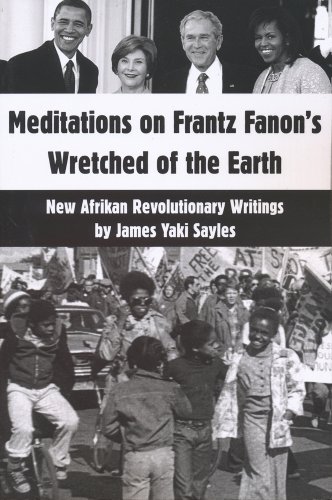
Imprisoned Intellectual: A Review of "Meditations on Frantz Fanon's Wretched of the Earth"
by Dan Berger, Left TurnMEDITATIONS ON FRANTZ FANON’S WRETCHED OF THE EARTH BY JAMES YAKI SAYLES
Kersplebedeb and Spear and Shield Publications, 2010
For more than twenty years, James Yaki Sayles (also known as Atiba Shanna) was one of the most profound theorists writing from within US prisons. Yaki turned his decades of confinement into a time to theorize and a place to strategize, working to maintain connections between what was happening inside prisons and what was happening outside of them.
Subscribe to:
Posts (Atom)