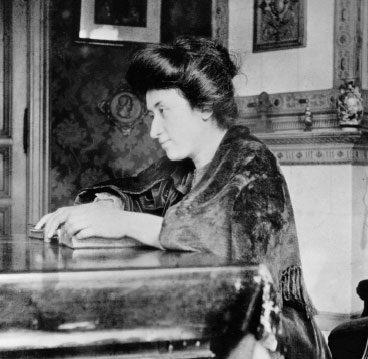
Showing posts with label Rosa Luxemburg. Show all posts

Thursday, 22 December 2011

The Rosa Luxemburg Reader

edited by Peter Hudis and Kevin B. Anderson, Monthly Review Press

Among the major Marxist thinkers of the period of the Russian Revolution, Rosa Luxemburg stands out as one who speaks to our own time. Her legacy grows in relevance as the global character of the capitalist market becomes more apparent and the critique of bureaucratic power more widely accepted within the movement for human liberation.

Thursday, 17 November 2011

The Accumulation of Capital

by Rosa Luxemburg, Radical eBook Archive

Rosa Luxemburg was a revolutionary socialist who fought and died for her beliefs. In January 1919, after being arrested for her involvement in a workers' uprising in Berlin, she was brutally murdered by a group of right-wing soldiers. Her body was recovered days later from a canal. Six years earlier she had published what was undoubtedly her finest achievement, The Accumulation of Capital - a book which remains one of the masterpieces of socialist literature. Taking Marx as her starting point, she offers an independent and fiercely critical explanation of the economic and political consequences of capitalism in the context of the turbulent times in which she lived, reinterpreting events in the United States, Europe, China, Russia and the British Empire. Many today believe there is no alternative to global capitalism. This book is a timely and forceful statement of an opposing view.

Thursday, 1 September 2011

Organisational Questions of the Russian Revolution

Rosa Luxemburg
Rosa Luxemburg
by Rosa Luxemburg, 1904, LibCom

This text is a translation of two articles entitled 'Organisational Questions of Russian Social Democracy', written by Rosa Luxemburg in 1904.
The translation was made by the United Workers' Party in America and first published in Britain in Pamphlet form in 1935 by the Anti- Parliamentary Communist Federation. It was later republished by the Independent Labour Party in the 1960s and went under the title of "Leninism or Marxism?" This text was scanned from the ILP pamphlet. In the 1935 edition, several of the paragraphs were transposed. This version follows the 1935 edition, except for a few grammatical amendments.

Monday, 22 August 2011

London Calling: Fanon, Spontaneity and the English insurrections

Nigel C. Gibson
Every time a man has contributed to the victory of the spirit, every time a man says no to an attempt to subjugate his fellows, I have felt solidarity with his act … Yes to life. Yes to love. Yes to generosity … No to the contempt … No to degradation… No to exploitation … No to the butchery of what is most human … freedom.
Fanon

Friday, 22 July 2011

What more could we want of ourselves!

by Jacqueline Rose, The London Review of Books

The Letters of Rosa Luxemburg edited by Georg Adler, Peter Hudis and Annelies Laschitza, translated by George Shriver
Verso, 609 pp, £25.00, February 2011, ISBN 978 1 84467 453 4

We live in revolutionary times. I cannot imagine now what it would have been like to be thinking about Rosa Luxemburg if the revolutions in Tunisia, Egypt and Libya had not taken place. I do not know whether it would have been easier or more difficult. But one thing revolutionary moments do is force us to revise our sense of time, stretching us between past and future, as we comb backwards for the first signs of upheaval, and look forward to see what is to come. For many observers, but mainly those in power, the uncertainty is a way of stalling the movement of revolution, curbing its spirit by calling it to account in advance for a future that it can’t predict or foretell. These are the fear-mongers, who point to a range of monstrous outcomes – say, anarchy or Islamic control – as a way of discrediting what is happening this moment, now; who manipulate the dread of a terrible future (and the future may always be terrible) to dull the sounds of freedom.

Rosa Luxemburg: Online Texts

Via the Marxists Internet Archive

Rosa Luxemburg
1894: What Are the Origins of May Day?
1896: The Polish Question at the International Congress in London
1896: Social Democracy and the National Struggles in Turkey
1898: The Industrial Development of Poland
1898: Opportunism and the art of the possible
1898: Speeches to Stuttgart Congress
1899: Speech to the Hanover Congress
1899: The Dreyfus Affair and the Millerand Case
1899: Militia and Militarism
1900: Reform or Revolution
1901: The Socialist Crisis in France
1901: To the National Council of the French Worker’s Party
1902: Martinique
1902: The Eight Hour Day at the Party Congress
1903: An anti-clerical policy of Socialism