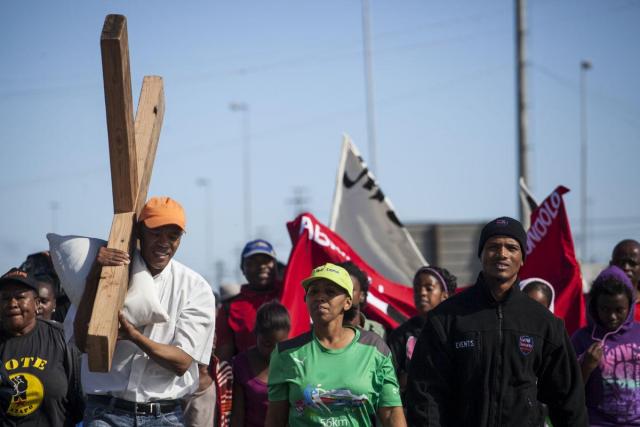
Showing posts with label Popular Protest. Show all posts

Thursday, 10 December 2015

After the Water War

Oscar Olivera, ROAR Magazine

In Latin America, the struggle for water as a common good is present in almost all environmental conflicts—sparked by extractive, industrial, highway and energy projects—but also forms part of the agenda of urban and labor movements rallying against privatization, shortages, sanitation problems, and so on.

This does not come as a surprise, since water—as a common good and as a human right—is an essential part of our lifeworld, of how we relate to the planet and to each other. Water to be consumed and managed by humans; water for the reproduction of life; water as a living entity that flows and evolves; water as a sacred being or territory: all the above are perceptions radically opposed to water as a commodity, to water as a “resource” or financial asset.

Friday, 18 September 2015

They Die Out There: It Matters Not Where, Nor How

Richard Pithouse, CounterPunch

On Monday morning there was a protest, in the form of a road blockade, organised from a shack settlement in Durban, South Africa. The settlement, officially known as Quarry Road but popularly known as KwaMam’Suthu, is on a sliver of land that runs along a river bank squeezed between two busy roads. It is in the suburbs to the North of the city. The current sequence of open contestation between people occupying land in the interstices of this part of the city and the local state stretches back to the ‘80s. It has a prior history that, before the mass evictions of the ‘50s and ‘60s, came to a head in the late ‘20s and early ‘30s. Over the last decade it has ebbed and flowed as the state has alternated between offering material and political concessions and responding to struggle with increasingly violent repression. Recently things have been getting hot again. Last month residents from the nearby Kennedy Road settlement burnt a municipal truck during two days of protest.

Monday, 8 December 2014

Constituent Power in the Modern World: A Brief Introduction

Department of Politics & International Relations, Rhodes University
Constituent Power in the Modern World: A Brief Introduction

A post-graduate course to be taught by Richard Pithouse in the first semester, 2015
Throughout the modern era … constituent power has been in conflict with constituted power, the fixed power of formal constitutions and central authority. Whereas constituent power opens each revolutionary process, throwing open the doors to the forces of change and the myriad desires of the multitude, constituted power closes down the revolution and brings it back to order. In each of the modern revolutions, the State rose up in opposition to the democratic and revolutionary forces and imposes a return to a constituted order, a new Thermidor, which either recuperated or repressed the constituent impulses. The conflict between active constituent power and reactive constituted power is what characterizes these revolutionary experiences.
-         From the introduction to Antonio Negri’s Insurgencies: Constituent Power and the Modern State (1999)

Monday, 31 March 2014

A revolution’s dreams betrayed

Protests are rooted in the frustration and despair of poverty and rage at an uncaring government, writes Malaika wa Azania. The Sunday Independent

 In his poignant masterpiece Harlem, renowned poet Langston Hughes reflects on the nervous conditions of African-Americans whose dream of emancipation from the draconian laws of racial segregation has been aborted in the inter-city ghettos that are concentration camps.

There, levels of poverty, destitution and unemployment are soaring and drugs and alcohol serve as escape routes from the unbearable heaviness of tortured existence.

Hughes asks:

“What happens to a dream deferred?

Does it dry up like a raisin in the sun?

Or fester like a sore – and then run?

Does it stink like rotten meat?

Or crust and sugar over – like a syrupy sweet?

Maybe it just sags like a heavy load.

Or does it explode?”

Wednesday, 19 March 2014

Makana Municipality Bans another March

Tuesday, 18 March 2014
Unemployed People's Movement Press Statement

Makana Municipality Bans another March

Municipalities around the country are banning marches and supressing the right to protest. The Makana Municipality in Grahamstown is one of the worst offenders.

The year before last they illegally banned one of our marches on the grounds that one of our comrades was on a list provided by intelligence of people who are not allowed to address public gatherings unless the riot police are present. We had to go to court to march and when we did march riot police came from all over the Eastern Cape to monitor our comrade.

Wednesday, 5 February 2014

South Africa’s water wars

by Mandy de Waal, GroundUp

Ma Gladys Mphepho hovers over a pot on a two plate cooker in her shack in Papamani, an informal settlement outside of Grahamstown. “We do not have dignity,” she says, stirring the rice, flavoured with beef stock, that is her family’s Sunday lunch. “We do not know what it means to have dignity. Forget about any question of dignity,” says Mphepho.

It is a sweltering day in the heat of summer and Mphepho is talking about her daily struggle to live, which is exacerbated by the crisis that the people of Papamani, and greater Grahamstown, have with water. There are two taps in the whole of Papamani which serve close on 30 homes. Each home houses some five or six people. Do the maths, and that’s over 150 people who get water from two taps. That’s to drink, make food with, to wash with and to do anything else that requires water.

Thursday, 28 November 2013

Julius Malema: It's Just a Jump to the Left, And Then a Step to the Right

Richard Pithouse, SACSIS

Being against [one form of] evil doesn't make you good.
- Ernest Hemingway, Islands in the Stream, 1952

Over the last ten years or so there has been an extraordinary degree of popular protest in South Africa. The seemingly incorrigible elitism of the higher reaches of our public sphere has meant that, particularly in the absence of sustained formal organisation, popular protest has seldom won the right to represent itself in this space. For years the media, NGOs, academy and political parties were able to substitute the presentation of their own assumptions, frequently inflected with crude stereotypes, for rational and democratic engagement. However now that the scale and tenacity of popular dissent is being more widely recognised there is an astonishing array of actors trying to capture it, or bits of it, including political parties, NGOs, activists of various sorts, minor political sects, entrepreneurs, tenderpreneurs and people with religious, ethnic and cultural projects.

Friday, 1 November 2013

Cry me a river of crocodile tears

Sisonke Msimang
Sisonke Msimang, The Daily Maverick

It is March. Anene Booysen is mutilated, murdered and raped. We are shamed into action, shaken by the brutality of the crime. We imagine our own seventeen year olds and we pray that her soul rests in peace.

It is October. Zandile and Yonelisa are murdered in communal toilets in Diepsloot. We think about our own babies, fat and brown swaying precariously on newly found feet. We wonder what their mothers would have felt. We want to weep.We are outraged.

Monday, 21 October 2013

A Path Through the Embers and into the Agora?

A Path Through the Embers and into the Agora?
- Notes on the Necessity for our Democratic Imagination to Take Better Measure of the World

Richard Pithouse

Retrieving life and the human from waste

Achille Mbembe has argued that the rendering of human beings as waste by the interface of racism and capitalism in South Africa means that “for the democratic project to have any future at all, it should necessarily take the form of a conscious attempt to retrieve life and 'the human' from a history of waste”. He adds that “the concepts of 'the human', or of 'humanism', inherited from the West will not suffice. We will have to take seriously the anthropological embeddedness of such terms in long histories of "the human" as waste.” Mbembe is not the first to want to hold on to the idea of the human in the face of the systemic denial of the full and equal humanity of all people and to insist that the idea of the human needs to be delinked from what AimĂ© CĂ©sairecalled 'pseudo-humanism' – colonial particularities masquerading as universal. CĂ©saire aspired to “a true humanism . . . a humanism made to the measure of the world”. Steve Biko envisioned a “true humanity”.

A Path Through the Embers and into the Agora?

A Path Through the Embers and into the Agora?
- Notes on the Necessity for our Democratic Imagination to Take Better Measure of the World

Richard Pithouse

Achille Mbembe has argued that the rendering of human beings as waste by the interface of racism and capitalism in South Africa means that “for the democratic project to have any future at all, it should necessarily take the form of a conscious attempt to retrieve life and 'the human' from a history of waste”. He adds that “the concepts of 'the human', or of 'humanism', inherited from the West will not suffice. We will have to take seriously the anthropological embeddedness of such terms in long histories of "the human" as waste.” Mbembe is not the first to want to hold on to the idea of the human in the face of the systemic denial of the full and equal humanity of all people but to insist that the idea of the human needs to be delinked from what AimĂ© CĂ©saire called 'pseudo-humanism' – colonial particularities masquerading as universal. CĂ©saire aspired to “a true humanism....a humanism made to the measure of the world”. Steve Biko envisioned a “true humanity”.

Tuesday, 7 May 2013

The Regulation of Protests under Jacob Zuma - Jane Duncan 7 May 2013

The Regulation of Protests under Jacob Zuma

by Professor Jane Duncan

Faculty of Humanities Seminar Room
5:00 p.m. 7 May 2013

Death by a thousand pinpricks - South Africa’s ever-vanishing right to protest

A great deal of media coverage has been given to ‘violent’ protests. But it’s a narrow view just to assume that the protestors are being violent; abuse is a two-way street – especially if bureaucracy is being used to quash dissent. By ANDREA ROYEPPEN AND JANE DUNCAN. The Daily Maverick

Friday, 26 April 2013

Critical Studies Seminar: Richard Pithouse - Conjunctural remarks on the political significance of 'the local'

The weekly Critical Studies Seminar Series, which is held jointly by the departments of Sociology and Political Studies, is presenting the following seminar:

Topic: Conjunctural remarks on the political significance of 'the local'
Presenter: Richard Pithouse
Venue: Politics Seminar Room
Date & Time: Friday April 26th from 1 pm to 2:30 pm

Friday, 22 February 2013

No end in sight for police brutality in South Africa

Justice Malala
by Justice Malala, The Guardian, 22 February 2013

People thought they would see no more peaceful protesters shot by police, but the force is turning violent again.

In July 2009 South Africa's then new police commissioner, Bheki Cele, told a newspaper he wanted the law to be changed to allow police to "shoot to kill" suspects without worrying about "what happens after that".

Two months later a young woman, Olga Kekana, was going out with three friends in a Pretoria township when she was shot through the head. The car she was travelling in was "mistaken" by police for one driven by car hijackers.