Showing posts with label Postcolonialism. Show all posts

Wednesday, 25 September 2013

Gramsci and the Postcolonial World

The Postcolonial Gramsci edited by Neelam Srivastava and Baidik Bhattacharya (New York: Routledge), 2012; pp 288, £85

Reviewed by Arun K. Patnaik, Economic & Political Weekly

The book under review, while explaining the relevance of Gramsci’s thoughts in the postcolonial world, deals with three key concerns: the role of intellectuals, cultural hegemony and neo-liberal political economy. Drawing upon the above three resources from different geographies in the postcolonial world, the book draws our attention to how Gramsci’s ideas have travelled across the globe from Peru, Algeria, India to China and elsewhere.

Wednesday, 22 May 2013

End of Postcolonialism and the Challenge for ‘Non-European’ Thought

by Aditya Nigam, Critical Encounters

A lively debate has been going on lately in Al Jazeera, following the question posed by Hamid Dabashi in an article provocatively titled “Can Non-Europeans Think?" Dabashi’s piece, published earlier in January this year was a response to an article by Santiago Zabala, Research Professor of Philosophy at the University of Barcelona. Zabala’s article, entitled “Slavoj Zizek and the Role of the Philosopher”, was actually on an entirely different issue, as will be evident from the title. Zabala attempts, in this article, to read in Zizek’s persona and oeuvre, the possible implications for the philosopher as such. He dwells on Zizek as a figure who is at once a philosopher and a public intellectual – a role not very easily available, according to him, to academic philosophers.

Wednesday, 24 April 2013

The fetish of “the West” in postcolonial theory

by Neil Lazarus, 2004

In a commentary entitled “East isn’t East,” which appeared not long
ago in the Times Literary Supplement, Edward Said proposed that one
of the essential gestures of postcolonial criticism, and one of its enduring
achievements, rested in what he called its “consistent critique
of Eurocentrism” (1995: 5). In the pages that follow, I would like to
put some pressure on this assessment. My intention is not, of course,
to suggest that the postcolonialist critique of Eurocentrism has not
been significant in helping to expose the tendentiousness, chauvinism,
and sheer pervasiveness of the ideological formation that Said
himself, in his seminal study of 1978, addressed under the rubric of
Orientalism. I take it for granted that it has, and believe moreover that
to argue otherwise would be simply perverse. Rather, my aim in this
chapter is to suggest that in the field of postcolonial studies at large,
including in the work of some of the field’s most audacious and theoretically
sophisticated practitioners, Eurocentrism has typically been
viewed not as an ideology or mode of representation but as itself the
very basis of domination in the colonial and modern imperial contexts.

Tuesday, 23 April 2013

How Does the Subaltern Speak?

by Vivek Chibber, The Jacobin

Postcolonial theory discounts the enduring value of Enlightenment universalism at its own peril.

In recent decades, postcolonial theory has largely displaced Marxism as the dominant perspective among intellectuals engaged in the project of critically examining the relationship between the Western and non-Western worlds. Originating in the humanities, postcolonial theory has subse­quently become increasingly influential in history, anthropology, and the social sciences. Its rejection of the universalisms and meta-narratives associated with Enlightenment thought dovetailed with the broader turn of the intellectual left during the 1980s and 1990s.

Wednesday, 19 December 2012

Under Western Eyes: Feminist Scholarship and Colonial Discourses

Chandra Talpade Mohanty, 1988

It ought to be of some political significance at least that the term "colonization" has come to denote a variety of phenomena in recent feminist and left writings in general. From its analytic value as a category of exploitative economic exchange in both traditional and contemporary marxisms (particularly contemporary theorists such as Baran, Amin and Gunder-Frank) to its use by feminist women of color in the U.S. to describe the appropriation of their experiences and struggles by hegemonic white women's movements, colonization has been used to characterize everything from the most evident economic and political hierarchies to the production of a particular cultural discourse about what is called the "Third World."' However sophisticated or problematical its use as an explanatory construct, colonization almost invariably implies a relation of structural domination, and a supression—often violent—of the heterogeneity of the subject(s) in question. What I wish to analyze is specifically the production of the "Third World Woman" as a singular monolithic subject in some recent (Western) feminist texts. The definition of colonization I wish to invoke here is a predominantly discursive one, focusing on a certain mode of appropriation and codification of "scholarship" and "knowledge" about women in the third world by particular analytic categories employed in specific writings on the subject which take as their referent feminist interests as they have been articulated in the U.S. and Western Europe.

Thursday, 20 September 2012

Subaltern Studies and Postcolonial Historiography

by Dipesh Chakrabarty, 2000

Subaltern Studies: Writings on Indian History and Society began in 1982 as a series of interventions in some debates specific to the writing of modern Indian history. Ranajit Guha (b.1923), a historian of India then teaching at the University of Sussex, was the inspiration behind it. Guha and eight younger scholars based in India, the United Kingdom, and Australia constituted the editorial collective of Subaltern Studies until 1988, when Guha retired from the team. The series now has a global presence that goes well beyond India or South Asia as an area of academic specialization. The intellectual reach of Subaltern Studies now also exceeds that of the discipline of history. Postcolonial theorists of diverse disciplinary backgrounds have taken interest in the series. Much discussed, for instance, are the ways in which contributors to Subaltern Studies have participated in contemporary critiques of history and nationalism, and of orientalism and Eurocentrism in the construction of social science knowledge. At the same time, there have also been discussions of Subaltern Studies in many history and social science journals. Selections from the series have been published in English, Spanish, Bengali, and Hindi and are in the process of being brought out in Tamil and Japanese. A Latin American Subaltern Studies Association was established in North America in 1992. It would not be unfair to say that the expression “subaltern studies,” once the name of a series of publications in Indian history, now stands as a general designation for a field of studies often seen as a close relative of postcolonialism.

Thursday, 17 May 2012

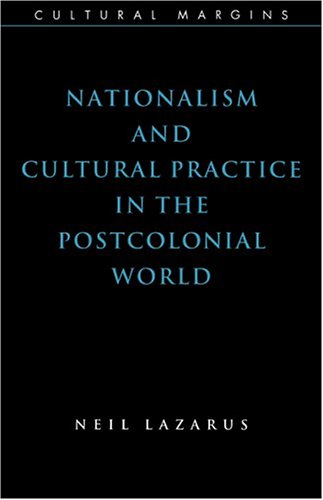
Nationalism and Cultural Practice in the Postcolonial World


by Neil Lazarus, 1999

This wide-ranging study contains individual chapers on modernity, globalization and the "West," nationalism and decolonization, cricket and popular consciousness in the English-speaking Caribbean, and African pop music. Neil Lazarus offers extended discussions of the work of such influential writers, critics and activists as Frantz Fanon, C. L. R. James, Edward Said, Gayatri Spivak, Samir Amin, Raymond Williams, Paul Gilroy and Partha Chatterjee. This book is a politically focused, materialist intervention into postcolonial and cultural studies, and constitutes a major reappraisal of the debates on politics and culture in these fields.

Monday, 9 April 2012

The Postcolonial Unconsciousness

The Postcolonial Unconsciousness
by Neil Lazarus, Cambridge, 2011

The Postcolonial Unconscious is a major attempt to reconstruct the whole field of postcolonial studies. In this magisterial and, at times, polemical study, Neil Lazarus argues that the key critical concepts that form the very foundation of the field need to be re-assessed and questioned. Drawing on a vast range of literary sources, Lazarus investigates works and authors from Latin America and the Caribbean, Africa and the Arab world, South, Southeast and East Asia, to reconsider them from a postcolonial perspective. Alongside this, he offers bold new readings of some of the most influential figures in the field: Fredric Jameson, Edward Said and Frantz Fanon.

Thursday, 15 September 2011

On the Postcolony

Achille Mbembe is one of the most brilliant theorists of postcolonial studies writing today. In On the Postcolony he profoundly renews our understanding of power and subjectivity in Africa. In a series of provocative essays, Mbembe contests diehard Africanist and nativist perspectives as well as some of the key assumptions of postcolonial theory.

This thought-provoking and groundbreaking collection of essays—his first book to be published in English—develops and extends debates first ignited by his well-known 1992 article "Provisional Notes on the Postcolony," in which he developed his notion of the "banality of power" in contemporary Africa. Mbembe reinterprets the meanings of death, utopia, and the divine libido as part of the new theoretical perspectives he offers on the constitution of power. He works with the complex registers of bodily subjectivity — violence, wonder, and laughter — to profoundly contest categories of oppression and resistance, autonomy and subjection, and state and civil society that marked the social theory of the late twentieth century.

Monday, 15 August 2011

Absolutely Postcolonial

Absolutely Postcolonial
This innovative book provides an incisive critique of well-established positions in postcolonial theory and a dramatic expansion in the range of interpretative tools available. Peter Hallward gives substantial readings of four significant writers whose work invites, to varying degrees, a singular interpretation of postcolonialism: Edouard Glissant, Charles Johnson, Mohammed Dib, and Severo Sarduy.

Saturday, 25 June 2011

What is postcolonial thinking? An interview with Achille Mbembe

Eurozine, 2008

The faults in Europe's universalism, especially when confronting its colonial history, have nurtured a variety of critical perspectives in the West. Talking to French magazine Esprit, theorist Achille Mbembe says that postcolonial thinking looks so original because it developed in a transnational, eclectic vein from the very start. This enabled it to combine the anti-imperialist tradition with the fledgling subaltern studies and a specific take on globalization, he says.