Showing posts with label Lewis Gordon. Show all posts

Thursday, 21 July 2016

On Frantz Fanon: An Interview With Lewis R. Gordon

Lewis Gordon

Kirchgassner: Describe the time in your life when you first read Frantz Fanon. What were your initial impressions of his writings and why is Fanon still important for your own work today?

Gordon: I first attempted to read Fanon when I was about thirteen years of age. My uncle, Shaleem Solomon, is a Rastafarian. He had a collection of books on Black Liberation, which included writings by Almicar Cabral, Frantz Fanon, and Kwame Nkrumah. I found Fanon’s prose gripping, but I didn’t yet know about the thinkers to whom he was referring and the contexts of his discussion beyond the clear ones of colonialism and racism. Those ideas stayed in the back of my mind, however, as I soon after at fourteen read works by Malcolm X, James Baldwin, and Angela Davis, with additions of G.W.F. Hegel and Karl Marx. When I read Jean-Jacques Rousseau during my years at Lehman College, I kept hearing the voice of Fanon. I was delighted to see Les Damnés de la terre (“The Damned of the Earth,” more popularly known as “The Wretched of the Earth”) in M. Shawn Copeland’s graduate seminar on Political Theology when I was a doctoral student at Yale, and the supervisor of my dissertation, the late Professor Maurice Natanson, was very enthusiastic about his inclusion in the thesis. Fanon became a constant presence in my work because he addressed human affairs, particularly those pertaining to Black people, with a heavy dose of something often unfashionable in the academy: reality.

Friday, 12 February 2016

On Frantz Fanon: An Interview With Lewis R. Gordon

In today’s guest post, Brooks Kirchgassner, ‎Political Director at the Central Indiana Labor Council in Indianapolis, interviews Professor Lewis R. Gordon about his latest book, What Fanon Said: A Philosophical Introduction to His Life and Thought. AAIHS

Kirchgassner: Describe the time in your life when you first read Frantz Fanon. What were your initial impressions of his writings and why is Fanon still important for your own work today?

Gordon: I first attempted to read Fanon when I was about thirteen years of age. My uncle, Shaleem Solomon, is a Rastafarian. He had a collection of books on Black Liberation, which included writings by Almicar Cabral, Frantz Fanon, and Kwame Nkrumah. I found Fanon’s prose gripping, but I didn’t yet know about the thinkers to whom he was referring and the contexts of his discussion beyond the clear ones of colonialism and racism. Those ideas stayed in the back of my mind, however, as I soon after at fourteen read works by Malcolm X, James Baldwin, and Angela Davis, with additions of G.W.F. Hegel and Karl Marx. When I read Jean-Jacques Rousseau during my years at Lehman College, I kept hearing the voice of Fanon. I was delighted to see Les Damnés de la terre (“The Damned of the Earth,” more popularly known as “The Wretched of the Earth”) in M. Shawn Copeland’s graduate seminar on Political Theology when I was a doctoral student at Yale, and the supervisor of my dissertation, the late Professor Maurice Natanson, was very enthusiastic about his inclusion in the thesis. Fanon became a constant presence in my work because he addressed human affairs, particularly those pertaining to Black people, with a heavy dose of something often unfashionable in the academy: reality.

Monday, 6 October 2014

The Blackhouse Philosopher in Soweto Series: Lewis Gordon - 7 October 2013


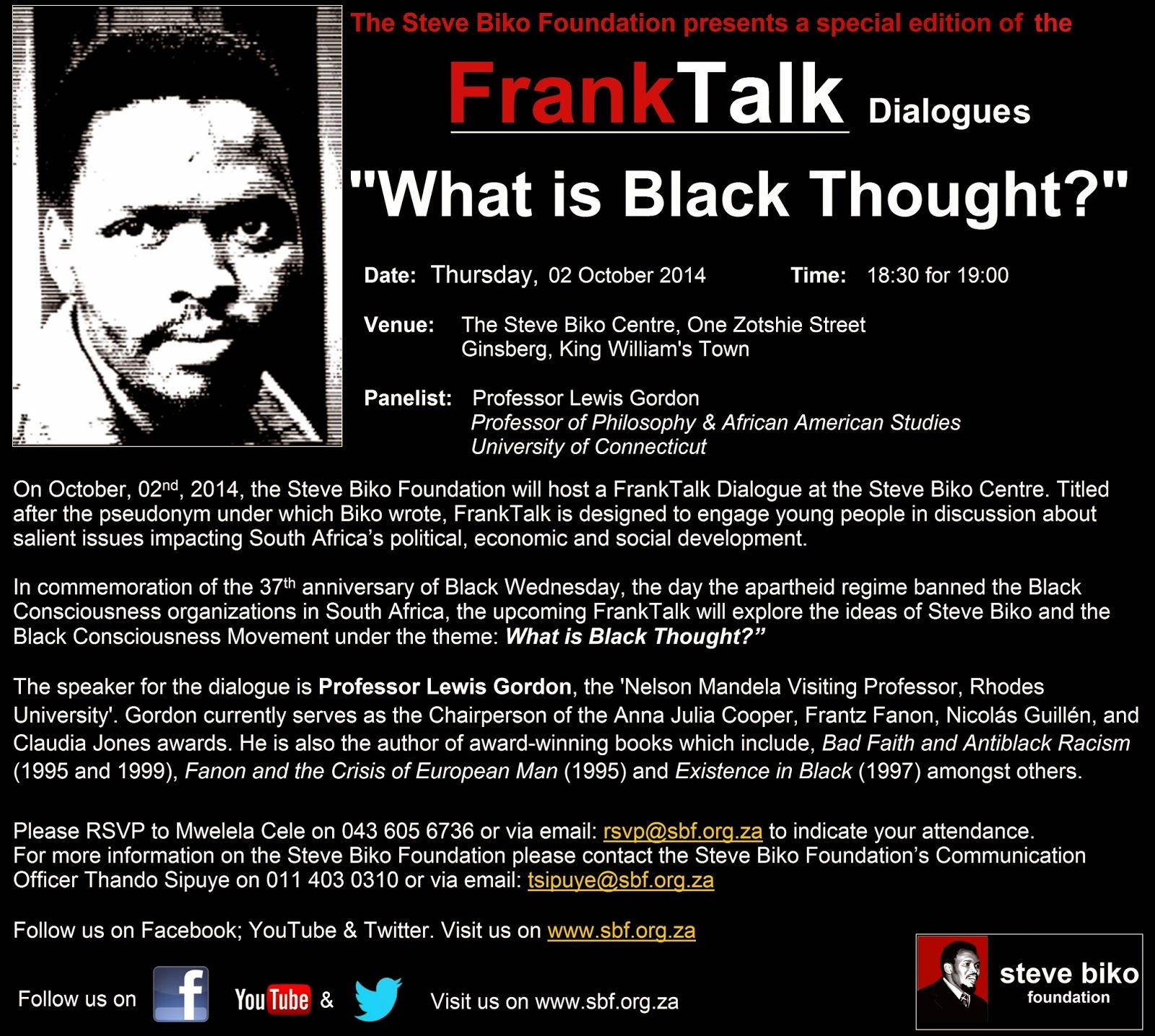
Welcoming Address by Mwalela Cele at the Presentation by Professor Lewis Gordon at the FrankTalk Dialogues, Steve Biko Centre, 3 October 2014

“A people without a positive history is like a vehicle without an engine.” Steve Biko as Frank Talk (We Blacks)

“Black Consciousness is an attitude of mind and a way of life, the most positive call to emanate from the black world for a long time.” Steve Biko
(Black Consciousness and the Quest for A True Humanity)

Thank you Program Director: Greetings ladies and gentlemen.

Welcome to the Steve Biko Centre, a project of the Steve Biko Foundation.
And welcome to the special edition of the FrankTalk Dialogues entitled:
What is Black Thought?’ I would like to greet our Guest Speaker, Professor
Lewis Gordon. I welcome him very warmly to the spiritual home of black consciousness, right here in Ginsberg, King William’s Town (eQonce).