Tuesday, 30 April 2013

Eusebius McKaiser Launches 'A Bantu In My Bathroom' at Rhodes on 3 May 2013


You are cordially invited to Eusebius McKaiser's launch for his book A Bantu In My Bathroom this Friday, 3 May 2013, at Eden Grove Blue, 14:00, Rhodes University. The book is a collection of essays about race, sexuality and other uncomfortable South African topics. A best-seller within a couple of weeks of publication, it has just been printed for the fourth time in six months.

Eusebius McKaiser, is a well-known political analyst who writes widely for local and international press. He is currently a columnist for The Star and Cape Times where his weekly column appears on Mondays. His work has appeared internationally in publications such as The New Republic, BBC, Focus on Africa and, also, The New York Times.

Eusebius studied law and philosophy at Rhodes University before spending time at Oxford as a Rhodes Scholar. He also lectures part-time in philosophy. And he is a radio talk show host, most recently with Talk Radio 702 and soon with a new radio station about to be launched.

Monday, 29 April 2013

The Runaway Union

by Aman Sethi, The Hindu

Emperors Palace casino — edifice of dreams, self-proclaimed Vegas of Africa with its 1,724 slot machines, 68 gaming tables, and giant fibreglass statues of Egyptian pharaohs — is a five-minute drive from Johannesburg airport.

In a country of desperate inequality, the casino offers one way past the seemingly impermeable barriers of race and class. Yet, Emperors Palace is a bet in itself, a wager, placed by the National Union of Mineworkers (NUM) on behalf of its many thousand members that money pulled from gamblers’ pockets in Johannesburg will find its way past the city’s smart suburbs into the streaked overalls of men crouched at a faraway mine face thousands of feet underground.

Sunday, 28 April 2013

Anger over South Africa award to Burnham

by Rickey Singh, The Jamaica Observer

THE recent decision by the South Africa Government to confer on Guyana's late President Forbes Burnham its highest national honour designated for outstanding foreign citizens- — the Oliver Tambo Award (gold) — has drawn strong criticisms from two well-known Jamaican scholars and Pan-Africanists — Dr Rupert Lewis and Dr Horace Campbell.
Both have expressed shock and sadness in wondering aloud whether President Jacob Zuma's Administration had in effect posthumously rewarded the former Guyana head of state for the June 13, 1980 assassination of Walter Rodney, the internationally famous Guyanese historian and Pan-Africanist crusader for freedom and justice.

Friday, 26 April 2013

Critical Studies Seminar: Richard Pithouse - Conjunctural remarks on the political significance of 'the local'

The weekly Critical Studies Seminar Series, which is held jointly by the departments of Sociology and Political Studies, is presenting the following seminar:

Topic: Conjunctural remarks on the political significance of 'the local'
Presenter: Richard Pithouse
Venue: Politics Seminar Room
Date & Time: Friday April 26th from 1 pm to 2:30 pm

Public Lecture by Ananya Roy in Johannesburg: Making Slum-Free Cities: Global Urbanism in the Asian Century

The School of Architecture and Planning at the University of the Witwatersrand, invites you to attend the 2013 Rusty Bernstein Memorial Lecture.

Making Slum-Free Cities: Global Urbanism in the Asian Century

Delivered by Ananya Roy, Professor of City and Regional Planning and Distinguished Chair in Global Poverty and Practice at the University of California, Berkeley.

Date: 16 May 2013
Time: 17h30 for 18h00 to 20h30
Venue: Dorothy Susskind Auditorium, John Moffat Building, East Campus,
University of the Witwatersrand

Thursday, 25 April 2013

Conflict of Interest, Inc: Mining unions' leaders were representing their members while in corporations' pay

A Daily Maverick investigation has revealed a furtive conflict of interest, with mining houses footing the bill for top National Union of Mineworkers office bearers’ salaries. The hard-to-believe arrangement started in the late eighties as the means of protecting union leaders from the corporations, but it was retained over the years, creating a severe of conflict of interest. Unionists are being paid high salaries by the very people from whom they are supposed to protect their members. The 'arrangement' is just about to end, in spite of union leaders' unhappiness and an unpredictable labour and political backlash. By GREG MARINOVICH. The Daily Maverick

Wednesday, 24 April 2013

Colonial Present : Legacies of the Past in Contemporary Urban Practices in Cape Town, South Africa

by Faranak Miraftab, 2012

This article historicizes the contemporary urban development and governance strategies in Cape Town, South Africa, by focusing on two periods: the British colonial era (mid to turn of the nineteenth century) and the neoliberal postapartheid era (early twenty-first century). It reveals the keen affinity between a contemporary urban strategy known as Improvement Districts for the affluent
and the old colonial practice of ‘‘location creation’’ for the native. Discussing the similarities and differences in the material and discursive practices by which urban privilege is produced and maintained in Cape Town across the two eras, the study brings to light the colonial legacies of the neoliberal municipal strategies for governance of urban inequalities. This insight is significant to the
citizens’ resistance against exclusionary redevelopment projects that claim ‘‘innovation’’ in urban management.

The fetish of “the West” in postcolonial theory

by Neil Lazarus, 2004

In a commentary entitled “East isn’t East,” which appeared not long
ago in the Times Literary Supplement, Edward Said proposed that one
of the essential gestures of postcolonial criticism, and one of its enduring
achievements, rested in what he called its “consistent critique
of Eurocentrism” (1995: 5). In the pages that follow, I would like to
put some pressure on this assessment. My intention is not, of course,
to suggest that the postcolonialist critique of Eurocentrism has not
been significant in helping to expose the tendentiousness, chauvinism,
and sheer pervasiveness of the ideological formation that Said
himself, in his seminal study of 1978, addressed under the rubric of
Orientalism. I take it for granted that it has, and believe moreover that
to argue otherwise would be simply perverse. Rather, my aim in this
chapter is to suggest that in the field of postcolonial studies at large,
including in the work of some of the field’s most audacious and theoretically
sophisticated practitioners, Eurocentrism has typically been
viewed not as an ideology or mode of representation but as itself the
very basis of domination in the colonial and modern imperial contexts.

The Secret History of the Vietnam War

By Daniel Denvir, Vice

If you thought you knew all there was to know about the Vietnam War, you were wrong. For example: ever heard of the "Mere Gook Rule," a code of conduct the US military came up with in order to make it easier for soldiers to murder Vietnamese civilians without feeling too bad about it? ("It's only a mere gook you're killing!")

Well, few people knew about this bit of history either until author Nick Turse discovered it in secret US military archives, which he used as the primary sources for his new(ish) book, Kill Everything That Moves: The Real American War in Vietnam. The book is based on Turse's discovery of theretofore secret internal military investigations of US-perpetrated atrocities alongside extensive reporting in Vietnam and among American veterans, and it reminds us that the most significant fact about the Vietnam War is its most overlooked: massive and devastating Vietnamese civilian suffering.

Tuesday, 23 April 2013

How Does the Subaltern Speak?

by Vivek Chibber, The Jacobin

Postcolonial theory discounts the enduring value of Enlightenment universalism at its own peril.

In recent decades, postcolonial theory has largely displaced Marxism as the dominant perspective among intellectuals engaged in the project of critically examining the relationship between the Western and non-Western worlds. Originating in the humanities, postcolonial theory has subse­quently become increasingly influential in history, anthropology, and the social sciences. Its rejection of the universalisms and meta-narratives associated with Enlightenment thought dovetailed with the broader turn of the intellectual left during the 1980s and 1990s.

George Bizos: Law, Justice & Morality in South Africa: The Past & the Present

(Talk given to the School of Practical Philosophy During Plato Week - 22 April 2013)

Professors, academics, philosophers, students and interested guests:

1.  It is my honour to have been asked to speak at Plato Week in South Africa by the School of Practical Philosophy. I would like to thank Stephen Meintjies and David Horan for making this week possible. For those of you who may not know me, I am of Greek origin and accordingly it has brought me endless joy to conduct some of my research in preparation for this speech.

Monday, 22 April 2013

Frank Chikane Launches 'The Things That Could Not be Said' in New Brighton, Port Elizabeth, 30 April 2013

Frank Chikane will launch his new book the The Things That Could Not be Said at The Herald/NMMU Community Dialogue at the Red Location Museum, New Brighton, Port Elizabeth, on 30 April 2013.  Richard Pithouse - writer, activist and lecturer at Rhodes University - will be the discussant. 

Sunday, 21 April 2013

Is the ANC rewarding Forbes Burnham for the assassination of Walter Rodney?

by Horace Campbell, 21 April 2013

Walter Rodney was assassinated on June 13, 1980.

At the time of his assassination, Forbes Burnham was the President. Since the assassination, there have been numerous calls for an investigation into the circumstances of the killing. The brother of Walter Rodney, Donald Rodney, survived and told the world that the bomb that assassinated Walter Rodney was placed by Gregory Smith. Smith was an operative from the Guyanese Defense force and he was spirited out of the country to the colonial territory of Cayenne. He died there after more than twenty years. There has never been an inquiry into the assassination.

From May 2008 to 2011: Xenophobic Violence and National Subjectivity in South Africa

by Judith Hayem, Journal of Southern African Studies, 2013

This article examines the recurrence of xenophobic attacks in 2011 in the light of the events of May 2008. Using archives and secondary data, examining slogans and discourses heard at the time and reflecting on the author’s own involvement as an activist alongside foreign residents displaced by the 2008 attacks, it is argued that the xenophobic attacks demonstrated a shift in the national subjectivity or conception of citizenship, from an inclusive notion implying participation in the future South African society to a dialectical representation of nationals against foreigners. It is further argued that, in its mismanagement of the 2008 crisis, the South African government contributed to the emergence of such attitudes and did nothing to stop the violence; hence its repetition. The notion of human rights that has emerged in South Africa is one of the keys to an understanding of the representations at stake: whereas human rights used to be a universal and founding notion in post-apartheid South Africa, they are now seen as a national privilege regarding access to basic needs. The article shows that the humanitarian management of the May 2008 crisis by the South African Government contributed considerably to obscuring the notion of ‘human rights’. In order to oppose such a dangerous policy, there is an urgent need to revive the political debate in South Africa.

Saturday, 20 April 2013

‘A Little Feu de Joie’

by Adam Shatz, London Review of Books
  • Days of God: The Revolution in Iran and Its Consequences by James Buchan
    John Murray, 482 pp, £25.00, November 2012, ISBN 978 1 84854 066 8

At the end of the Second World War, an anonymous pamphlet surfaced in the seminaries of Qom, the bastion of Shia learning. The Unveiling of Secrets accused Iran’s monarchy of treason: ‘In your European hats, you strolled the boulevards, ogling the naked girls, and thought yourselves fine fellows, unaware that foreigners were carting off the country’s patrimony and resources.’ Iran, it proposed, should be ruled by an assembly of religious jurists headed by a wise man. In such a state, there would be no need for elections or a parliament, or even a standing army: a religious militia (basij) would ensure obedience to the law.

Centenary of the 1913 Land Act

by Colin Bundy, Amandla

Why consider the history of a hundred-year old law? Surely the Marikana massacre and farm-workers' strikes are more urgent? In fact, there are direct links between the Natives' Land Act of 1913 and current struggles. The Land Act and its consequences still shape rural South Africa and complicate contemporary programmes of restitution and land reform.

The Land Act was not a sudden departure, nor did it transform the countryside. It followed a long history of colonial conquest and dispossession; it codified and ratified various discriminatory practices established in colonies and Boer republics. In order to understand the Act's core features, we need to recall how land alienation took place in British colonies and Boer republics before Union.

COSATU: a house divided

By Benjamin Fogel, Amandla!

COSATU is in the midst of the biggest crisis in its 27-year history. This crisis has arisen from an SACP-driven attempt to oust democratically elected COSATU General Secretary Zwelinzima Vavi, under the guise of corruption charges. The conflict's roots are in longstanding political contradictions and ideological tensions between COSATU and its Alliance partners – the ANC and the SACP. At stake is not only the leadership of COSATU, but its political and moral direction.

Friday, 19 April 2013

E. San Juan, Jr: Edward Said's Affiliations; Secular Humanism and Marxism

Emeritus Professor of Anthropology Bernard Magubane Dies

University of Connecticut

Professor emeritus Bernard Makhosezwe Magubane, a South African who was a longtime anthropology professor at the University of Connecticut, died April 12 at his home in South Africa. He was 82.

Born Aug. 26, 1930 on a farm near Colenso in Natal, Magubane rose to become one of South Africa’s leading scholars, teaching at the University of Connecticut for 27 years. As a representative in the United States of the liberation movement, the African National Congress, Magubane led the successful, anti-apartheid divestment campaign in the state of Connecticut, and helped coordinate similar activities throughout the U.S.

The truth about extreme global inequality


Valentin Y. Mudimbe: Africa remains the absolute difference—An interview

The Idea of Africa

Valentin Mudimbe: In order to understand “Invention of Africa”, we can use a number of entries, levels of interpretations which were made by scholars, journalists and anthropologists, in order to define the specificity of Africa. We have levels of comprehension and understanding the history of the West; its everyday life, practices and its ethno-philosophy, and indeed the practice of disciplines such as history, sociology, theology and the philosophical level in its two dimensions. I distinguish the semiological from the hermeneutic form. The first is understood as the totality of skills and knowledge that allows one to describe what one is seeing in social science. The second as the totality of skills and knowledge that allows one to read meanings. That is the first entry; the levels of interpretation of what is going on in a given society, which thus could qualify Africa as abnormal. We can also see that abnormality or difference, by using a model, the mode of production.

Talking about a revolution with John Holloway


“There is a growing sense throughout the world that capitalism isn’t working; and that the cracks we create in it may really be the only way forward.”

 - San Andrés de Cholula, Mexico, 03/04/13

On the outskirts of Puebla and at the foot of the giant Popocatépetl volcano lies the sleepy Mexican town of San Andrés de Cholula. It is here that, on a sunny April afternoon, we meet John Holloway. Often referred to as “the philosopher of the Zapatistas”, Holloway — who is a Professor of Sociology at the Autonomous University of Puebla — is widely known for his anti-statist conception of revolution and his intellectual support for autonomous anti-capitalist movements around the world. The publication in 2002 of his influential book, Change the World without Taking Power: The Meaning of Revolution Today, unleashed a veritable firestorm of both praise and criticism from fellow radicals and helped to provoke a period of profound introspection in Leftist circles on the meaning and necessity of revolution in the post-Cold War context of globalized financial capitalism.

Revolution in Bad Times

By Asef Bayat, New Left Review

Back in 2011, the Arab uprisings were celebrated as world-changing events that would re-define the spirit of our political times. The astonishing spread of these mass uprisings, followed soon after by the Occupy protests, left observers in little doubt that they were witnessing an unprecedented phenomenon—‘something totally new’, ‘open-ended’, a ‘movement without a name’; revolutions that heralded a novel path to emancipation. According to Alain Badiou, Tahrir Square and all the activities which took place there—fighting, barricading, camping, debating, cooking and caring for the wounded—constituted the ‘communism of movement’; posited as an alternative to the conventional liberal-democratic or authoritarian state, this was a universal concept that heralded a new way of doing politics—a true revolution. For Slavoj Žižek, only these ‘totally new’ political happenings, without hegemonic organizations, charismatic leaderships or party apparatuses, could create what he called the ‘magic of Tahrir’. For Hardt and Negri, the Arab Spring, Europe’s indignado protests and Occupy Wall Street expressed the longing of the multitude for a ‘real democracy’, a different kind of polity that might supplant the hopeless liberal variety worn threadbare by corporate capitalism. These movements, in sum, represented the ‘new global revolutions’. [1]

Monday, 15 April 2013

COSATU's history: coming full circle

Interview with Dirk Hartford, the first head of COSATU media and editor of COSATU News in the 1980's, about the implications of the current tensions in COSATU. Amandla!

Amandla!: What do you make of what is happening in COSATU now with the allegations against its General Secretary, Zwelinzima Vavi ?

DH: I think what we are seeing is a direct result of the decisive victory of the Zuma-SACP faction at the December ANC Congress in Mangaung. The SACP essentially triumphed at Mangaung, and now has more people in the ANC's NEC, government and Cabinet than ever before. They are on the offensive to take out any significant opposing voices in the Alliance. Julius Malema, the ANCYL NEC, and the Limpopo NEC are already history. Now they are coming for the biggest thorn in their sides, which has always been Vavi and the independent trade union or worker views that he reflects.

The African Spring: Frantz Fanon Today and the Legacy of Revolutionary Humanism

A Conversation with Drucilla Cornell

April 23, 2013 from 6.30 - 8.30 pm, Room 9204/9205

Frantz Fanon’s work is so significant to us today because it continues to give us an entirely different philosophical perspective on the ethical and political significance of a new way of being human together. Fanon both rejects traditional European narratives of why humans are unique and deserving of dignity and those anti- or post-humanists who argue that we are already beyond the human, either through evolution or in a political and ethical sense. To put it simply: the colonial situation is one of systematic dehumanization. The human, however, is not a set of attributes, whether real or ideal. Instead, what it means to be human together in a world beyond the terrifying brutalities of colonialism is only to be found in the revolutionary struggle itself.” (Drucilla Cornell)

Discussants: David Harvey, Peter Hitchcock, and Kyoo Lee

Permanent Reproductive Crisis: An Interview with Silvia Federici

by Marina Vishmidt, Mute Magazine, 7 March 2013

On the occasion of the publication of an anthology of her writing and the accession of a  Wages for Housework NY archive at Mayday Rooms in London, Marina Vishmidt interviewed Silvia Federici on her extensive contribution to feminist thought and recent work on debt activism (with contributions by Mute, Mayday Rooms and George Caffentzis)

Black people are poor, not stupid

by Malaika wa Azania, Thought Leader,15 April 2013

I am terribly annoyed by academics and political analysts in this country. It has become a Herculean task for me to even read their works and research based on the conditions of black people, particularly in the townships and rural areas. Most of these academic papers and articles, whatever issue they deal with, however different the research methodology employed, seem to be arriving at the same conclusion about the consciousness of our people. The conclusion is that the toiling masses in townships and rural areas, the majority of them black, are ignorant or stupid.

We Created Chávez: by George Ciccariello-Maher

Nina Simone : Mississippi Goddam

Robin Kelley: "The Long Rise and Short Decline of American Democracy"

Sunday, 14 April 2013

Marikana: the Massacre and its Meaning - 22 April 2013

The Faculty of Humanities invites you to attend the following seminar:

Prof Peter Alexander, Professor of Sociology at the University of Johannesburg, where he holds the South African Chair in Social Change.

Title: Marikana: the Massacre and its Meaning

Date: Monday 22nd April 2013
Time: 5pm
Venue: Faculty of Humanities Seminar Room, Cnr Somerset & Prince Alfred Streets

Discussants:

Camalita Naicker, MA Candidate, Political and International Studies
Nosipho Mngomezulu, MA Candidate, Anthropology

Class in Soweto Seminar & Book Launch with Peter Alexander 19 April 2013


How Hani brought politics to villagers

Nomboniso Gasa
by Nomboniso Gasa, Independent Online, 14 April 2014

As the sun hung above the Cacadu River the question echoed in the hamlets and villages: “Is it him? Is this the son of Tshonyane?”

The cars stopped outside a humble homestead.

Transkei Defence Force and Umkhonto weSizwe soldiers jumped out of their cars, making way for the returning son of the village.

Friday, 12 April 2013

Neruda, Pinochet, and the Iron Lady

Jon Lee Anderson, The New Yorker

It’s curious, historically speaking, that Margaret Thatcher died on the same day that forensic specialists, in Chile, exhumed the remains of the late, great Chilean poet Pablo Neruda. The author of the epic “Twenty Love Poems and a Song of Despair” and the winner of the 1971 Nobel Prize in Literature, Neruda died at the age of sixty-nine, supposedly of prostate cancer, just twelve days after the violent September 11, 1973, military coup launched by army chief Augusto Pinochet against the country’s elected Socialist President, Salvador Allende. Warplanes had strafed the Presidential palace, and Allende had bravely held out, but committed suicide with a rifle given to him by Cuba’s President Fidel Castro as Pinochet’s goons stormed into the Presidential palace. Neruda was a close friend and supporter of Allende’s; he was ill, but in the midst of planning to leave the country for Mexico, where he had been invited to go into exile. When he was on his deathbed in a clinic, his home had been broken into by soldiers and trashed.

Thursday, 11 April 2013

The Jacob Zuma Rape Trial: Power and African National Congress (ANC) Masculinities

Mandisi Majavu's Review of "Fanonian Practices'

Journal of Contemporary African Studies, 2013

Fanonian practices in South Africa: from Steve Biko to Abahlali baseMjondolo, by
Nigel Gibson, Durban, University of KwaZulu-Natal Press, 2011, 312 pp., R248
(paperback), ISBN 9781869141974

In Fanonian Practices, Gibson recreates Fanon’s philosophy of liberation in line with new realities. He traces Fanonian practices in South Africa from Steve Biko in the 1970s up to the emergence of Abahlali baseMjondolo in post-apartheid South Africa. According to Gibson, Biko’s critique of the white liberal idea of integration was derived in part from Fanon’s notion of Black Consciousness. Fanon’s Black Consciousness is a critique directed at blacks who internalise white supremacist values and beliefs. Black Skin White Masks basically maps out Fanon’s Black Consciousness in detail. According to Gibson, Fanon later developed this critique to explore how in the post-colonial context the black elite betray the emancipatory goals of the anti-colonial movement partly because of a ‘desire for a place in the machinery of colonial/capitalist expropriation’ (61).

Wednesday, 10 April 2013

Grant Farred: Not the Moment After, but the Moment Of

Grant Farred: Not the Moment After, but the Moment Of by TigersEye99

Black, not Noir

Adam Shatz, London Review of Books

'That Smell’ and ‘Notes from Prison’ by Sonallah Ibrahim, translated by Robyn Creswell
New Directions, 110 pp, £11.99, March, ISBN 978 0 8112 2036 1

When we first meet the nameless narrator of Sonallah Ibrahim’s 1966 novella That Smell, he’s just been released from prison, but no one is there to greet him, and he’s in no mood to celebrate. He remains under house arrest, free to wander the streets of Cairo so long as he returns home by dusk, when his police minder has to sign off on his curfew. Things could be worse: he could be back in prison, where he remembers being beaten, ‘shaking with cold and fear’. But when he looks for ‘some feeling that was out of the ordinary, some joy or delight or excitement’, he draws a blank. On the night of his release, the police throw him into a filthy holding pen because he has nowhere to stay:

There were a lot of men there and the door kept opening to let more in. I felt something in my knee. I put my hand down and sensed something wet. I looked at my hand and found a big patch of blood on my fingers and in the next moment saw swarms of bugs on my clothing and I stood up and noticed for the first time big patches of blood smeared on the walls of the cell and one of the men laughed and said to me: Come here.

Understanding Henri Lefebvre (by Stuart Elden)


Lefebvre had an extraordinary life. It stretched from the very beginning of
the century until a decade before its end. It is no surprise that his French
biographer has accordingly called his work the adventure of the century!
Born eighteen years after Marx's death, and only six after Engels', Lefebvre
was a youth of sixteen at the Russian Revolution, in his late thirties at the
outbreak of World War Two, 60 at the time of the Cuban missile crisis, and
still writing at the fall of the Berlin Wall. He obtained his licence in philosophy
the year Althusser was born, and published his first articles two years
before Foucault's birth, yet outlived both of them.

Tuesday, 9 April 2013

The People Shall Obey

by Richard Pithouse, SACSIS

In his speech at the memorial service for the soldiers who were killed in the Central African Republic Jacob Zuma presented us, and not for the first time, with the idea that we should receive another accumulation of bodies – of black bodies – as a tragedy, as a cruel consequence of the random movement of the wheel of fortune. Thabo Mbeki, watching our steady accretion of 'tragedies' from the sidelines, might, perhaps, have recalled a line from Shakespeare: “Our remedies oft in ourselves do lie, Which we ascribe to heaven: the fated sky.”

CLR James: A Boundary that broke down barriers

C.L.R. James

by Selma James, The Mail & Guardian

Fifty years ago, after a March in the United Kingdom as cold as the one just gone, my husband CLR James's semiautobiographical Beyond a Boundary appeared as the cricket season opened. Reviews were favourable but none even approached the incomparable (and antiracist) John Arlott's in Wisden, "the cricketers' Bible".

Monday, 8 April 2013

Demolition Job

Postcolonial Theory &
the Specter of Capital
Rosinka Chaudhuri, The Indian Express

Book: Postcolonial Theory and the Specter of Capital
Author: Vivek Chibber
Publisher: Navayana
Price: Rs 450
Pages: 306

Vivek Chibber does not like the Subaltern Studies historians, and his mission in this book is to tear down the early theories of, in his order of importance, Ranajit Guha, Dipesh Chakrabarty and Partha Chatterjee. What these historians have influentially said seems to him to be simply wrong-headed and methodologically dubious; his favourite descriptions of them here are as "cultural essentialists" and "Orientalists" (the latter without reference to Edward Said, who is mentioned only once on page eight). Culture, in fact, is a bad word for him in general, and one of his main objections to the Subalternists is the primacy they choose to give to cultural locations.

Cocoa is blood and they are eating my flesh

Toby Green, London Review of Books
  • Chocolate Islands: Cocoa, Slavery and Colonial Africa by Catherine Higgs
    Ohio, 230 pp, £24.95, June 2012, ISBN 978 0 8214 2006 5
For centuries, the region that now straddles northern Angola and the western part of the Democratic Republic of Congo formed a political and cultural whole. South of what the BaKongo knew as the Zaire river lay the heartland of the Kingdom of Kongo, one of the most powerful states of West-Central Africa. Kongo sat at the crossroads of trade routes linking the forests of the interior with the arid coastal areas near Luanda, in Angola, and the savannahs of the plateau further north. These deep-rooted connections meant that slaving wars in one area influenced the political stability of the rest of the region. In the late 17th and 18th centuries, Kongo and Ndongo – the kingdom at the heart of what is now Angola – fractured into warring statelets whose main business was to bring slaves to the coast, thus helping Atlantic slavery to reach ever further into Central Africa. These countries remain interlocked, involved in geopolitical struggles for coltan, diamonds, oil and timber.

Sunday, 7 April 2013

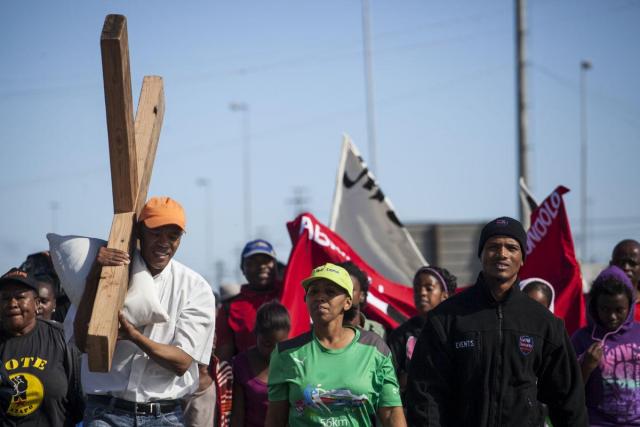
Welcome to Hell: A march through the SA townships - Cape Town, 30 March 2013

Welcome to Hell: A march through the SA townships - Cape Town, 30 March 2013

African-American Philosophy, Race, and the Geography of Reason

Lewis Gordon
by Lewis Gordon, 2006

African-American philosophy has been one of the most recently developed areas of theoretical reflection in African-American Studies. Its emergence is in many ways marked by the  realization of many scholars that philosophy offered much to the enterprise of studying the  African diaspora, and the unique categories of thought endemic to that diaspora offers many challenges to modern and contemporary philosophy. Central in this development has been the importance of philosophical anthropology in the study of race and the challenges posed by race to our understanding of philosophical anthropology. Added to this insight is the anxiety that is a function of studying Africana communities and the ideas they stimulate. 

Winnie Madikizela-Mandela and the ghosts of crimes past

by Ken Good, Politics Web

News reports suggest that investigations into the fate of certain young men linked to Winnie Madikizela-Mandela may be re-opened. There is a great deal of published evidence of her complicity in gross human rights violations. Since the mid-1980s the gap between the public appearance of this lady and her household, personal behaviour has been huge. A thorough examination of this record is long over due.

Saturday, 6 April 2013

African Theory Course 2013: Schedule of Study

Thinking Africa, Department of Politics & International Relations

African Theory Course 2013: Schedule of Study

This course is the part of the Thinking Africa Project in the Department of Politics & International Relations. The course has two primary objectives this year. The first is to give students an opportunity to seriously engage a set of texts central to the African canon. The second is to prepare students for the colloquium that will be held at Rhodes on the work of V.Y. Mudimbe in August this year.  Mudimbe, a scholar of major global stature, first visited Rhodes in 2011 for the Fanon colloquium hosted by Thinking Africa and will return for this year’s colloquium. Thinking Africa is also publishing Mudimbe’s new book which will be launched at the colloquium.

Decolonising the humanities

by Suren Pillay, Mail & Guardian

What does it mean to pursue critical scholarship in the humanities and social sciences in a settler colonial society trying to move beyond the category "settler" and "native" towards becoming the citizenry bequeathed to us by our political settlement?

This is the question all South African universities share, however differently they were marked by apartheid. Its urgency is fuelled partly by the daunting demographic anxiety the humanities and social sciences face because of declining enrolment and the very worrying reality that we do not produce enough graduate students, particularly black South African PhD graduates.

Africa in Theory

On Monday the 8th of April Achille Mbembe will be presenting "Africa in Theory" to the WISH seminar at WISER from 3:00 to 4:30pm.  We particularly ask those who will attend to read the paper prior to the event, as the presenter will not restate the content.

Abstract: As the new century unfolds, many increasingly acknowledge that there is no better laboratory than Africa to gauge the limits of our epistemological imagination or to pose new questions about how we know what we know and what that knowledge is grounded upon; how to draw on multiple models of time so as to avoid one-way causal models; how to open a space for broader comparative undertakings; and how to account for the multiplicity of the pathways and trajectories of change. In fact, there is no better terrain than Africa for a scholarship that is keen to describe novelty, originality and complexity, mindful of the fact that the ways in which societies compose and invent themselves in the present – what we could call the creativity of practice – is always ahead of the knowledge we can ever produce about them. As amply demonstrated by Jean and John Comaroff in a recent book, Theory From the South, the challenges to critical social theory are nowhere as acute as in the Southern Hemisphere, perhaps the epicenter of contemporary global transformations in any case the site of unfolding developments that are contradictory, uneven, contested, and for the most part undocumented.

Thursday, 4 April 2013

Conjunctural remarks on the political significance of ‘the local’


Richard Pithouse, Department of Political and International Studies, Rhodes University, PO Box 94, Grahamstown 6140, South Africa. 

Abstract

Popular protest is occurring on a remarkable scale in South Africa. Nonetheless, there is a significant degree to which it tends to be organized and articulated through the local. This contribution argues that while the political limitations of purely local modes of organization are clear, it should not be assumed that local struggles are some sort of misguided distraction from building a broader progressive movement. It is suggested that, on the contrary, the best prospects for the emergence of a broader popular struggle lie in building, sustaining and linking local struggles.

Wednesday, 3 April 2013

The Hospital at the Time of the Revolution – review

Michael Billington, The Guardian

It's always fascinating to see famous writers' early work. But the real value of this 100-minute, 1972 radio play by Caryl Churchill, which draws heavily on Frantz Fanon's The Wretched of the Earth, lies not so much in what it reveals about Churchill as what it says about its all too topical subject: the devastating impact of torture on practitioners as well as victims.

The Real Threat to BC Today

by Malaika Mahlatsi, GroundUp

On a cold afternoon in July 2010, a group of us met in Newtown to distribute pamphlets around the Johannesburg CBD and hotspots of the 2008 "xenophobic" attacks, such as Diepsloot etc. We were only about twelve, so we had to break into groups of four.

Three people would distribute flyers and one person would engage people to explain the cause we were fighting. Our campaign was called "Singamakwerekwere sonke", meaning "We are all foreigners". Basically, we were protesting against the deporting and the violence against our Afrikan brothers and sisters, whom our system calls "foreigners" and our people call "amakwerekwere". Our group was called SNI. We were young people who wanted change and we wanted it NOW!

Tuesday, 2 April 2013

La Commune (Paris, 1871)


Marxisms past and present

Kirk Helliker, Rhodes University, South Africa
Peter Vale, University of Johannesburg, South Africa

Abstract

Marxism was central to the understanding of South Africa’s struggle for freedom. This article provides a critical analysis of Marxist literature on South Africa since the 1970s, drawing out its relevance for contemporary analyses of the post-apartheid state and for radical politics today. It suggests that while the literature offered important insights into the character of the apartheid state, it failed to provide a critical appraisal of the state per se. Moreover, the capturing of state power by the liberation movement was not grounded in an understanding of the oppressive character of the state-form. The undermining of mainstream Marxism under neo-liberalizing conditions in post-apartheid South Africa has opened up the prospects for anti-statist radical libertarian thinking (including autonomist Marxism), and this thinking is consistent with the practices of certain autonomist popular politics currently emerging. Social theorizing on South Africa has had a complex relationship with Marxism. This article is interested in drawing on this experience in an effort to understand its implications for the ‘new’ South Africa where, 20 years after apartheid’s formal ending, social transformation remains caught in the logic not of Marxism but neo-liberalizing capitalism.