by Ian Macqueen, PhD Thesis, 2011
This thesis places Black Consciousness in comparative perspective with
progressive politics in South Africa in the late 1960s and the 1970s. It
argues that the dominant scholarly focus on Black Consciousness, which
is passed over as a ‘stage’ in the Black struggle against white
supremacy, insufficiently historicises the deeper roots, and the wider
resonances and ideological contestations of the Black Consciousness
movement. As they refined their political discourse, Black Consciousness
activists negotiated their way through the progressive ideologies that
flourished as part of the wider political and social ferment of the
1960s. Although Black Consciousness won over an influential minority of
radical Christians, a more contested struggle took place with nascent
feminism on university campuses and within the Movement; as well as with
a New Left-inspired historical and political critique that gained
influence among white activists.
Tuesday, 29 November 2011
Monday, 28 November 2011
The legacy of great Carribean thinkers
by Sonia Farmer, The
Nassau Guardian, Sunday, 27 November, 2011
As the College of The Bahamas continues in their efforts to earn University status, two instructors at the institution are helping things along with their new bold symposium that will be internationally attended, The College of the Bahamas Fanon Symposium 2011: 50 Years Later: Fanon’s Legacy and the Caribbean/Bahamas, scheduled for December 2.
As the College of The Bahamas continues in their efforts to earn University status, two instructors at the institution are helping things along with their new bold symposium that will be internationally attended, The College of the Bahamas Fanon Symposium 2011: 50 Years Later: Fanon’s Legacy and the Caribbean/Bahamas, scheduled for December 2.


Friday, 25 November 2011
Of an Obscure Disaster: On the End of the Truth of State."
Alain Badiou. "Of an Obscure Disaster: On the End of the Truth of State."in: lacanian ink. Vol. 22, Fall 2003. (English).
THE "TRIUMPH OF DEMOCRACY"?
Democracy triumphs on the ruins of communism, say our prose writers. Or it is going to triumph. The greatest triumphalists evoke the triumph of a "model of civilization." Ours. Nothing less. Those who say "civilization," especially in the form of a triumph, also proclaim the right of the civilized to their gunboats — for those who might not have understood in time on what side the trumpets of triumph sound. The rights of man are no longer a tired intellectual demand. It is the time for rights with muscle, for the right of intervention. Triumphal movements of democratic troops. The need for war, that obligatory correlate of triumphant civilizations. Iraqi deaths, accommodated in silence by millions, even exclusive of any count (and we know to what extent the civilization of which we speak is a counting one...), are only the anonymous remainder of triumphal operations. Shifty Muslims, after all, non-civilized recalcitrants. Because, take note, there is religion, and there is religion. The Christian and his Pope are part of civilization, rabbis are a considerable part, but Mullahs and Ayatollahs would do well to convert.
Philosophical Anthropology, Race, and the Political Econonmy of Disenfranchisement
By Lewis Gordon, 2005
It has been the
practice in recent, mainstream American political theory to
appeal to notions of facts from which to draw on the values
of American society and to formulate, from such facts,
Americans' unique notions of justice and freedom. This
approach rests upon an obvious suspension of notions of value
that transcend sociological and psychological factors, the
culmination of which is the almost slogan-like formulation by its
most eminent proponent, John Rawls, of his theory of
justice being "political, not metaphysical." Yet such
theorists are neither anthropologists nor sociologists, nor
for that matter, are they critical theorists, so the assessments they
make of "our values" are ultimately either
pseudo-social scientific or ultimately a priori notions of what,
given our considered judgments, we may believe in spite of
facts.
A Progressive Policy without Progressive Politics: Lessons from the failure to implement ‘Breaking New Ground'
by Richard Pithouse, Journal of Town & Regional Planning, 2009
This article provides a brief overview of post-apartheid housing policy. It argues that, in principle, ‘Breaking New Ground’ (BNG) was a major advance over the subsidy system but that the failure to implement BNG, which has now been followed by more formal moves away from a rights based and towards a security based approach, lie in the failure to take a properly political approach to the urban crisis. It is suggested that a technocratic approach privileges elite interests and that there could be better results from an explicitly pro-poor political approach – which would include direct support for poor people’s organisations to challenge elite interests, including those in the state, and to undertake independent innovation on their own.
This article provides a brief overview of post-apartheid housing policy. It argues that, in principle, ‘Breaking New Ground’ (BNG) was a major advance over the subsidy system but that the failure to implement BNG, which has now been followed by more formal moves away from a rights based and towards a security based approach, lie in the failure to take a properly political approach to the urban crisis. It is suggested that a technocratic approach privileges elite interests and that there could be better results from an explicitly pro-poor political approach – which would include direct support for poor people’s organisations to challenge elite interests, including those in the state, and to undertake independent innovation on their own.
The First Globalisation and Transnational Labour Activism in Southern Africa: White Labourism, the IWW, and the ICU, 1904–1934
by Lucien van der Walt, 2007
In this article, I argue that the history of labour and the working class in southern Africa in the first half of the twentieth century cannot be adequately understood within an analytical framework that takes the nation-state as the primary unit of analysis....This article.... examines three moments of transnational labour activism in southern Africa in the first three decades of the twentieth century. Firstly, there was the tradition of ‘White Labourism’: rather than being a peculiarly South African phenomenon, it originated in Australia, spread to South Africa in the early 1900s, and subsequently developed into a significant factor in labour politics in the Rhodesias by the 1920s. Secondly, there was the tradition of revolutionary syndicalism, which stressed interracial working-classsolidarity. As developed by the Industrial Workers of the World (the IWW or ‘Wobblies’) in the United States in 1905, this tradition came to South Africa via Scotland, where it spread from radical white labour circles to workers of colour in the 1910s, and then spilt over into the Australian IWW. Thirdly, there was the tradition of the Industrial and Commercial Workers’ Union (ICU), whose politics were an amalgam of two transcontinental currents: Garveyism and IWW syndicalism. The ICU operated regionally, spreading from South Africa in 1919 to South West Africa and the Rhodesias in the 1920s and 1930s. Set against the backdrop of regional waves of labour activism, the history of these transnational labour currents provides important insights into the social character of southern African labour movements in the period of the ‘first’ modern globalisation, lasting from the 1880s into the 1920s. The analysis presented here is influenced by, and makes a contribution to, the new transnational labour history that ‘relativizes’ and ‘historicizes’ the nation-state as a unit of analysis, stressing the ‘need to go beyond national boundaries’ and avoid ‘methodological nationalism’ in understanding working-class formation. A transnational labour history yields important insights into labour and working class history, provides a new synthesis that goes beyond old labour history, with its stress on formal organisation, and new labour history, with its stress on lived experience, and stresses the interconnections between labour worldwide.
In this article, I argue that the history of labour and the working class in southern Africa in the first half of the twentieth century cannot be adequately understood within an analytical framework that takes the nation-state as the primary unit of analysis....This article.... examines three moments of transnational labour activism in southern Africa in the first three decades of the twentieth century. Firstly, there was the tradition of ‘White Labourism’: rather than being a peculiarly South African phenomenon, it originated in Australia, spread to South Africa in the early 1900s, and subsequently developed into a significant factor in labour politics in the Rhodesias by the 1920s. Secondly, there was the tradition of revolutionary syndicalism, which stressed interracial working-classsolidarity. As developed by the Industrial Workers of the World (the IWW or ‘Wobblies’) in the United States in 1905, this tradition came to South Africa via Scotland, where it spread from radical white labour circles to workers of colour in the 1910s, and then spilt over into the Australian IWW. Thirdly, there was the tradition of the Industrial and Commercial Workers’ Union (ICU), whose politics were an amalgam of two transcontinental currents: Garveyism and IWW syndicalism. The ICU operated regionally, spreading from South Africa in 1919 to South West Africa and the Rhodesias in the 1920s and 1930s. Set against the backdrop of regional waves of labour activism, the history of these transnational labour currents provides important insights into the social character of southern African labour movements in the period of the ‘first’ modern globalisation, lasting from the 1880s into the 1920s. The analysis presented here is influenced by, and makes a contribution to, the new transnational labour history that ‘relativizes’ and ‘historicizes’ the nation-state as a unit of analysis, stressing the ‘need to go beyond national boundaries’ and avoid ‘methodological nationalism’ in understanding working-class formation. A transnational labour history yields important insights into labour and working class history, provides a new synthesis that goes beyond old labour history, with its stress on formal organisation, and new labour history, with its stress on lived experience, and stresses the interconnections between labour worldwide.
Thursday, 24 November 2011
Algerian Filmmaker Merzak Allouache Struggles with Censorship After Long Career
By Said Khatibi, Alakhbar
Critically acclaimed Algerian director Merzak Allouache tasted success early in his career, but when he tried confronting controversial subjects in his country he was censored.
 Merzak Allouache’s movies are groundbreaking inside and outside of
Algeria. He has become known as the voice of the people and a
politically engaging film director. He knows how to ride the waves of
criticism and win the affection of his audience.
Merzak Allouache’s movies are groundbreaking inside and outside of
Algeria. He has become known as the voice of the people and a
politically engaging film director. He knows how to ride the waves of
criticism and win the affection of his audience.
Critically acclaimed Algerian director Merzak Allouache tasted success early in his career, but when he tried confronting controversial subjects in his country he was censored.
Merzak Allouache’s movies are groundbreaking inside and outside of
Algeria. He has become known as the voice of the people and a
politically engaging film director. He knows how to ride the waves of
criticism and win the affection of his audience.
Everything; or: a short critique of identity politics
by
Grant Farred[i]
Identity
politics was founded as a critique of the grand narrative, charged
with inaugurating a different mode of struggle. Instead of the Great
White Man theory of history and politics, identity politics demanded
thinking the political in its specificity; it undertook, in the wake
of the post-War anti-colonial struggles and the anti-Establishment
turmoil that rocked Western societies in the 1960s, the thinking of
the Other. Identity politics sought to rearticulate the extant
political categories by, inter alia, complicating the workings of
class with race; attending to gender and sexual orientation in the
campaign for national liberation; foregrounding the constitutive
importance of ethnicity in political struggles. However, from its
inception identity politics has been haunted by the question of how
to think the specific against the grand political narrative.
South Africa: An Unfinished Revolution?
by Neville Alexander, The Fourth Strini Moodley Annual
Memorial Lecture, University of KwaZulu-Natal, 13 May 2010
In her historical novel, A
Place of Greater Safety, which is played out against the backdrop of the
Great French Revolution through an illuminating character analysis and
synthesis of three of that revolution's most prominent personalities, viz.,
Maximilien Robespierre, Georges Jacques Danton and Camille Desmoulins, Hilary
Mantel imagines the following conversation between Lucile Desmoulins and
Danton:
So has the Revolution a philosophy, Lucile wanted to know, has it a future?
She dared not ask Robespierre, or he would lecture her for the afternoon on the General Will: or Camille, for fear of a thoughtful and coherent two hours on the development of the Roman republic. So she asked Danton.
"Oh, I think it has a philosophy," he said seriously. "Grab what you can, and get out while the going's good."
Occupy has the power to effect change
by Peter Hallward, The Guardian
Occupy movements in the US went on the offensive last week, a few days after police forcibly cleared tents in cities from New York
to Oakland. In addition to holding their ground in the face of violent
intimidation, they began to interrupt business as usual. Rejecting the
logic that compels the poor to bail out the rich, they restricted access
to New York's stock exchange, they marched on bridges and subway
stations, they targeted banks and corporations, they overwhelmed university campuses.
Meanwhile, in defiance of an eviction order, Occupy London undertook a
"public repossession" of an abandoned office building and began its
conversion into a "bank of ideas";
in its first couple of days, this new variation on a public university
has already arranged a full schedule of meetings and talks about
privatisation, tax havens, globalisation, direct democracy, the Tobin
tax, photography and contemporary fiction. More forceful protests
against neoliberal austerity measures and other forms of tyranny,
meanwhile, have continued in Tahrir Square and in cities across Europe and the Middle East.
Insurgency and Spaces of Active Citizenship: The Story of Western Cape Anti-eviction Campaign in South Africa
by Faranak Miraftab & Shana Wills, 2005
This
article concerns the struggle waged by the poor in Cape Town, South
Africa, to assert
their constitutional rights to shelter and basic services and protect
their life spaces
against neoliberal policies. Using insurgent urbanism and active
citizenship as
its conceptual guide, this article attempts to enhance understanding
of grassroots spaces for practicing inclusive citizenship, stretching
beyond a limited interpretation of formal citizen participation.
Through the example of the Western Cape
Anti-Eviction Campaign in South Africa, the article aims to
contribute to a recent opening in the planning inquiry by overcoming
the selective definition of what
constitutes civil society and public participation and underlining
the significance of invited and invented spaces of citizen
participation in the formation of inclusive citizenship and just
cities.
Wednesday, 23 November 2011
Tuesday, 22 November 2011
Dark corners of the state we're in
Church Land Programme, Padkos
Just after the attacks on Kennedy Road in 2009, S'bu Zikode, then President of the shack-dwellers' movement, Abahlali baseMjondolo said: "This attack is an attempt to suppress the voice that has emerged from the dark corners of our country. That voice is the voice of ordinary poor people. This attack is an attempt to terrorise that voice back into the dark corners. It is an attempt to turn the frustration and anger of the poor onto the poor so that we will miss the real enemy. ... "Our crime is a simple one. We are guilty of giving the poor the courage to organise the poor. We are guilty of trying to give ourselves human values. We are guilty of expressing our views. Those in power are determined not to take instruction from the poor. They are determined that the people shall not govern. What prospects are there for the rest of the country if the invasion of Kennedy Road is overlooked? ... Our message to the movements, the academics, the churches and the human rights groups is this: We are calling for close and careful scrutiny into the nature of democracy in South Africa" (29th September 2009).
Just after the attacks on Kennedy Road in 2009, S'bu Zikode, then President of the shack-dwellers' movement, Abahlali baseMjondolo said: "This attack is an attempt to suppress the voice that has emerged from the dark corners of our country. That voice is the voice of ordinary poor people. This attack is an attempt to terrorise that voice back into the dark corners. It is an attempt to turn the frustration and anger of the poor onto the poor so that we will miss the real enemy. ... "Our crime is a simple one. We are guilty of giving the poor the courage to organise the poor. We are guilty of trying to give ourselves human values. We are guilty of expressing our views. Those in power are determined not to take instruction from the poor. They are determined that the people shall not govern. What prospects are there for the rest of the country if the invasion of Kennedy Road is overlooked? ... Our message to the movements, the academics, the churches and the human rights groups is this: We are calling for close and careful scrutiny into the nature of democracy in South Africa" (29th September 2009).
Life as Politics: How Ordinary People Change the Middle East
by Asef Bayat, Standford University Press, 2009

In the
popular imagination, the Muslim Middle East is frozen in its own
traditions and history—a land of mosques and minarets, veiled
women, despotic regimes, and desert sand. But this assumption fails
to recognize that social and political change comes in many guises.
In this eye-opening book, Asef Bayat reveals how under the shadow of
the authoritarian rule, religious moral authorities, and economic
elites, ordinary people can make meaningful change through the
practices of everyday life.
Though not as
visible on the world-stage as a mass protest or a full-scale
revolution, millions of people across the Middle East are discovering
or creating new social spaces within which to make their claims
heard. The street vendor who sets up his business in the main square,
squatters who take over public parks, Muslim youth who frequent
public hangouts in blue jeans, and protestors who march in the
streets, poor housewives who hang their wash in the alleyways, and
educated women who pursue careers doing "men's work"—all
these people challenge the state's control and implicity question the
established public order through their daily activities. Though not
coordinated in their activities, these "non-movements"
offer a political response, not of protest but of practice and direct
daily action.
Poem for South African Women
by June Jordan
Commemoration of the 40,000 women and children who,
August 9, 1956, presented themselves in bodily protest
against
the “dompass” in the capital of apartheid. Presented at The
United Nations, August 9, 1978.
Our own shadows disappear as the feet of thousands
by the tens of thousands pound the fallow land
into new dust that
rising like a marvelous pollen will be
fertile
even as the first woman whispering
imagination to the trees around her made
for righteous fruit
from such deliberate defense of life
as no other still
will claim inferior to any other safety
in the world
Sunday, 20 November 2011
The Coming War on the Occupy Movement
by George Ciccariello-Maher, CounterPunch
As I begin to write this, Occupy Oakland circulates in a by-now familiar pattern: forced from the camp at the break of day, the occupiers reconvened as they have done before on the steps of the Public Library. Later, they will attempt to close a repeating circuit that stretches a short six blocks along 14th Street between City Hall and the Library.
As I begin to write this, Occupy Oakland circulates in a by-now familiar pattern: forced from the camp at the break of day, the occupiers reconvened as they have done before on the steps of the Public Library. Later, they will attempt to close a repeating circuit that stretches a short six blocks along 14th Street between City Hall and the Library.
Outside the Law – review
Philip French, The Observer
The still highly controversial colonial war that France fought in Algeria
from the mid-1950s until the granting of independence in 1962 has only
been patchily reflected in the cinema. It figures significantly in the
background in films as different as Alain Resnais' Muriel and Michael Haneke's Hidden, and in 1966 there was Lost Command, a Hollywood version of Jean Lartéguy's French bestseller The Centurions
about a battalion of Indo-China veterans reassembling for another
bitter colonial conflict in Algeria. The only truly memorable movie is
the Marxist The Battle of Algiers (1966), set in the early days
of the revolution, directed by Gillo Pontecorvo and initiated by Yacef
Saadi, a leader of the FLN (National Liberation Front). Banned in France
for several years and regarded as one of the greatest political movies
ever made, The Battle of Algiers was shown by the Pentagon to
all senior officers and civil advisers going to Iraq and Afghanistan to
show "how to win a battle against terrorism and lose the war of ideas".
Saturday, 19 November 2011
South Africa on the Global Occupy Map


Transcript: KPFA Weekend News
Host: South Africa is the only African nation yet to appear on the Global Map of actions by the Occupy Movement. KPFA's Ann Garrison spoke to Ayanda Kota, Chair of the Grahamstown, South Africa Unemployed Peoples' Movement about Occupy South Africa.
Occult Economies and the Violence of Abstraction: Notes from the South African Postcolony
by Jean & John Comaroff, 1999
Postcolonial South
Africa, like other postrevolutionary societies, appears to have witnessed a dramatic
rise in occult economies: in the deployment, real or imagined, of magical means for
material ends. These embrace a wide range of phenomena, from "ritual
murder, "the sale ofbody parts, and the putative production
of zombies to pyramidschemes and
other financial scams.And they have led, in many places, to violent reactions
against people accused of illicit accumulation. In the struggles that have ensued, the
major lines of opposition have been not race or class but generation-mediated by
gender. Why is all this occurring with such intensity, right now?An answer to the
question, and to the more general problem ofmaking sense of the enchantments of
modernity, is sought in the encounter of rural South Africa with the contradictory
effects of millennia1 capitalism and the culture of neoliberalism.
This encounter, goes the argument, brings "the global"
and "the local"-treated here as analytic constructs rather
than explanatory terms or empirical realities-into a dialectical interplay. It also has implications for the practice of anthropology, challenging us to do ethnography on an "awkwardscale, on planes that transect the
here and now, then and there. [postcoloniality, modernity, millennia1 capitalism, occult economy, witchcraft, South Africa].
Friday, 18 November 2011
Open letter to all COMSA members from Fazel Khan
In 2007 Fazel Khan was fired from the University of
KwaZulu-Natal (UKZN) in Durban, South Africa, after leading a long strike the
previous year for workers' rights, student rights and academic freedom. In this
letter to his union he makes a case for a democratic university and, against
the extraordinary authoritarianism of much of the South African left, a
non-authoritarian radicalism.
Sunday, 29 April 2007
To all COMSA members
Comrades,
As you all know, last week I was finally fired after a 7
month disciplinary process. I am not the first person to have been forced out
of this university on political grounds in recent months. When I was fired I
was clearly told that I will not be the last.
May 1968, France: The LibCom Reading Guide
Libcom
Key texts
- Paris: May 1968 - Maurice Brinton's diary - A vivid and exciting eyewitness report by a member of Solidarity on the events in Paris in May 1968.
- Worker-Student Action Committees, France May '68 - Roger Gregoire and Fredy Perlman - In-depth look at the worker-student action committees formed during France May '68
- May-June 1968: A Situation Lacking in Workers' Autonomy - Mouvement Communiste - Detailed history and critical analysis of the May-June 1968 movement in France.
- Obsolete Communism: A Left-Wing Alternative - Daniel and Gabriel Cohn-Bendit - Excellent book on France 1968 by two participants, giving an account of the revolt as well as how it was co-opted with the help of the unions and French Communist Party.
Thursday, 17 November 2011
Transcolonial Fanon: Trajectories of a Revolutionary Politics
 Thursday, December 1 through Friday, December 2
Presented by Maison Française
Columbia University
Thursday, December 1, 7:30 p.m.
Frantz Fanon: His Life, His Struggle, His Work
Cheikh Djemai, 2001, 52 min.
This documentary traces the short and intense life of Frantz Fanon, one of the great thinkers of the 20th century.
The Oppressive Paradigm of the Colonial Academy
Mandisi Majavu, SACSIS
Almost two decades into post-apartheid South Africa many black academics still feel that the “white networks that have de facto run academic decision making” are derailing the transformation agenda. This is according to the Charter for Humanities and Social Sciences (CHSS), a report commissioned by the Minister of Higher Education and Training, that was published in June this year.
Almost two decades into post-apartheid South Africa many black academics still feel that the “white networks that have de facto run academic decision making” are derailing the transformation agenda. This is according to the Charter for Humanities and Social Sciences (CHSS), a report commissioned by the Minister of Higher Education and Training, that was published in June this year.
To Grasp Things by the Root
Richard Pithouse, SACSIS
Julius Malema, unlovely as he is, is a symptom, a morbid symptom to be sure, of the crisis that we face. Any assumption that his effective expulsion from the ANC allows us to continue with business as usual will guarantee the emergence of more symptoms, different but equally morbid.
Julius Malema, unlovely as he is, is a symptom, a morbid symptom to be sure, of the crisis that we face. Any assumption that his effective expulsion from the ANC allows us to continue with business as usual will guarantee the emergence of more symptoms, different but equally morbid.
The Accumulation of Capital

Rosa Luxemburg was a revolutionary socialist who fought and died for her beliefs. In January 1919, after being arrested for her involvement in a workers' uprising in Berlin, she was brutally murdered by a group of right-wing soldiers. Her body was recovered days later from a canal. Six years earlier she had published what was undoubtedly her finest achievement, The Accumulation of Capital - a book which remains one of the masterpieces of socialist literature. Taking Marx as her starting point, she offers an independent and fiercely critical explanation of the economic and political consequences of capitalism in the context of the turbulent times in which she lived, reinterpreting events in the United States, Europe, China, Russia and the British Empire. Many today believe there is no alternative to global capitalism. This book is a timely and forceful statement of an opposing view.
The Politics of Starving: An Interview with Raj Patel
Chandra
Kumar, Upping the Anti
In Stuffed
and Starved you
write about the international system of food production and
distribution. You argue that this system results in starvation and
obesity. Can you elaborate?
These
problems are an inevitable outcome of the way capitalism controls and
distributes food. When you distribute food through a capitalist
market, you’re guaranteed two outcomes: people who have money get
to eat, and people who don’t have money don’t get to eat. The
original imperial idea behind the creation of world food markets was
that they would allow people around the world to eat. But under this
model people who don’t have money go hungry, and it’s no accident
that these people live in the countries where food is grown.
Who Is the Subject of the Rights of Man?
by Jacques Rancière, 2004
What lies behind this strange shift from Man to Humanity and from Humanity to the Humanitarian? The actual subject of these Rights of Man became Human Rights. Is there not a bias in the statement of such rights? It was obviously impossible to revive the Marxist critique. But another form of suspicion could be revived: the suspicion that the ‘‘man’’ of the Rights of Man was a mere abstraction because the only real rights were the rights of citizens, the rights attached to a national community as such.
What lies behind this strange shift from Man to Humanity and from Humanity to the Humanitarian? The actual subject of these Rights of Man became Human Rights. Is there not a bias in the statement of such rights? It was obviously impossible to revive the Marxist critique. But another form of suspicion could be revived: the suspicion that the ‘‘man’’ of the Rights of Man was a mere abstraction because the only real rights were the rights of citizens, the rights attached to a national community as such.
Yvonne Vera interviewed by Jane Bryce
Interview with Yvonne Vera, 1st August 2000, Bulawayo, Zimbabwe. Weaver Press
When I recently met Yvonne Vera, I had read her earlier works, Nehanda and Without A Name, only because the publisher had given them to a mutual friend in London. To date, all her novels have been produced by the highly respected Zimbabwe publishing house, Baobab Books, Harare. It is the fate of African writers who choose to publish their work on the continent to be less well-known internationally than those whose work is taken up by metropolitan publishers. Yet what I had read of Yvonne Vera’s work had left me with a burning desire to find out more about her, and this was a major part of my decision to attend the Zimbabwe International Book Fair, fifteen years after my last visit to the country in 1985.
When I recently met Yvonne Vera, I had read her earlier works, Nehanda and Without A Name, only because the publisher had given them to a mutual friend in London. To date, all her novels have been produced by the highly respected Zimbabwe publishing house, Baobab Books, Harare. It is the fate of African writers who choose to publish their work on the continent to be less well-known internationally than those whose work is taken up by metropolitan publishers. Yet what I had read of Yvonne Vera’s work had left me with a burning desire to find out more about her, and this was a major part of my decision to attend the Zimbabwe International Book Fair, fifteen years after my last visit to the country in 1985.
Wednesday, 16 November 2011
Rescuing Fanon from the Critics
by Tony Martin, 1970
My real interest in Fanon dates from a night in August 1967 when, together with a couple hundred West Indian students in London, we converged on our Students' Center to listen to a lecture delivered by Stokely Carmichael. One or two of us in the audience had even been at primary school with him in Trinidad, though he probably didn't suspect it. "Can't you remember him?" asked an old classmate of mine, trying to jolt my memory. "He was always fighting!"
My real interest in Fanon dates from a night in August 1967 when, together with a couple hundred West Indian students in London, we converged on our Students' Center to listen to a lecture delivered by Stokely Carmichael. One or two of us in the audience had even been at primary school with him in Trinidad, though he probably didn't suspect it. "Can't you remember him?" asked an old classmate of mine, trying to jolt my memory. "He was always fighting!"
Peter Hallward on NGOs & Popular Struggles in Haiti
Click here to read '2003-2004 Preparing for War' which is chapter eight of Peter Hallward's Damming the Flood and deals with the role of NGOs in supporting the repression of the popular movement in Haiti.
Tuesday, 15 November 2011
Aspects of the International Class Struggle in Africa, the Caribbean and the Americas|
by Walter Rodney, 1974 (Via Marxists.Org)
Political conferences of the oppressed invariably attract a
variety of responses - varying from cynical conviction that they are an utter
waste of time to naïve optimism that they will change the face of the world. In
actuality, popular struggle continues from day to day at many different and
more profound levels; and its intensity at any given time primarily determines
the relevance and utility of the conference as a technique of co-ordination.
The Sixth Pan-African Congress scheduled for Dar es Salaam in June, 1974
consciously aims at being heir to a tradition of conferences which grew out of
the response of Africans to their oppression in the first half of this century.
Therefore, its rationale must be sought though a careful determination of the
co-ordinates of the contemporary endeavours of the African people everywhere.
Sunday, 13 November 2011
Neville Alexander - a linguistic revolutionary
by Khadija Patel, The Daily Maverick
In April this year, higher education minister Blade Nzimande raised
the ire of many South Africans when he suggested proficiency in an
“African” language would be a prerequisite for graduating from higher
education institutions. Speaking in isiZulu, Nzimande said:
"Akukwazi ukuba yithi kuphela ekuthiwa sifunde isingisi nesibhunu
bakwethu, kodwa ezethu iyilimi nabanye bangazifundi [We can't be
expected to learn English and Afrikaans, yet they don't learn our
languages"].
 |
| Neville Alexander |
Veneration and Struggle: Commemorating Frantz Fanon

As tradition has it, golden jubilees usually provide perfect occasions to reflect back on historical accomplishments that are recent enough to reminisce and important enough to still matter. The second decade of the 21st century marks such a reflective moment across the African world for those who find value in the lessons of the past, their contemporaneous applications and the implications of both for the visions of progress, prosperity and peace. The importance of this decade has already been determined by historical forces that are at least five decades old and the constant need to never forget them. Wherever in the African Diaspora one might exist, the significance of the decade of the 1960s reverberates in both the collective memories and the objective realities. As such, our effort in 2011 to eagerly and unapologetically reflect on the legacy of Frantz Fanon is motivated in one sense by the need to appreciate the iconic figures of the past.
- Kurt B. Young, from the Introduction
50 Years After Frantz Fanon: Namibian Youth Still Without Shoes
by Alfredo Tjiurimo Hengari, The Namibian
ABOUT three weeks ago, I attended a video projec- tion and discussion around the disturbing oeuvre of the extremely talented Congolese artist, Freddy Tsimba.
While Tsimba is brilliant, passionate about his sculptures, the Congo and his city Kinshasa, he remains a marginal artist, not only because he uses spent bullet casings in his sculptures to express despair and hope, but because he refuses to surrender his artistic independence to the state. About his beloved Kinshasa, he says: ‘Kinshasa est une très belle femme, mais elle est sans chaussures’ (Kinshasa is a very beautiful woman, but without shoes). Having grown up in dusty Katutura and spending long vacations in Otjimati, Epukiro (Omaheke), I understand what it means to feel grown-up, but still be deprived of shoes. It could imply both the physical and symbolic dehumanisation in front of peers and others with shoes.
College of the Bahamas Fanon Symposium 2011

50 Years Later: Fanon's Legacy and the Caribbean / Bahamas, College of the Bahamas
On
6 December 2011, 50 years will have passed since the death of Frantz
Fanon. Born in 1925 in the French colony of Martinique, Fanon's personal
experiences of everyday life under colonialism would yield two of the
most influential texts in anti-colonial revolutionary thought: Black Skin, White Masks (1952), and The Wretched of the Earth (1961).
Symposium Rationale
Frantz Fanon is today one of the most widely known and
influential Caribbean born theorists and revolutionary activists.
Nine Important Things
by Christopher McMichael, Mahala
I ran as an independent candidate in the local Makana Muncipality elections (Ward 12), a newly demarcated voting zone, including Rhodes University, in May this year. Representing the Students for Social Justice (SSJ), a recently formed non-hierarchical campus-based organisation, supported by the Unemployed Peoples Movement and the Democratic Left Front. On voting day, the DA won. I managed 130 votes. It may not sound like a lot but in actuality a bunch of students, without money or the support of a political party, missed coming second in the election (and beating the ANC) by just 8 votes.
I ran as an independent candidate in the local Makana Muncipality elections (Ward 12), a newly demarcated voting zone, including Rhodes University, in May this year. Representing the Students for Social Justice (SSJ), a recently formed non-hierarchical campus-based organisation, supported by the Unemployed Peoples Movement and the Democratic Left Front. On voting day, the DA won. I managed 130 votes. It may not sound like a lot but in actuality a bunch of students, without money or the support of a political party, missed coming second in the election (and beating the ANC) by just 8 votes.
Friday, 11 November 2011
Anarchism and syndicalism in an African port city: the revolutionary traditions of Cape Town's multiracial working class, 1904-1931
by Lucien van der Walt, Libcom
This paper examines the development of anarchism and syndicalism in early twentieth century Cape Town, South Africa, drawing attention to a crucial but neglected chapter of labor and left history. Central to this story were the anarchists in the local Social Democratic Federation (SDF), and the revolutionary syndicalists of the Industrial Socialist League, the Industrial Workers of Africa (IWA), and the Sweets and Jam Workers’ Industrial Union. These revolutionary anti-authoritarians, Africans, Coloureds and whites, fostered a multiracial radical movement – considerably preceding similar achievements by the Communist Party of South Africa (CPSA) in this port city. They were also part of a larger anarchist and syndicalist movement across the southern African subcontinent. Involved in activist centers, propaganda, public meetings, cooperatives, demonstrations, union organizing and strikes, and linked into international and national radical networks, Cape Town’s anarchists and syndicalists had an important impact on organizations like the African Political Organization (APO), the Cape Federation of Labour Unions, the Cape Native Congress, the CPSA, the General Workers Union, and the Industrial and Commercial Workers Union of Africa (ICU). This paper is therefore also a contribution to the recovery of the history of the first generation of African and Coloured anti-capitalist radicals, and part of a growing international interest in anarchist and syndicalist history.
This paper examines the development of anarchism and syndicalism in early twentieth century Cape Town, South Africa, drawing attention to a crucial but neglected chapter of labor and left history. Central to this story were the anarchists in the local Social Democratic Federation (SDF), and the revolutionary syndicalists of the Industrial Socialist League, the Industrial Workers of Africa (IWA), and the Sweets and Jam Workers’ Industrial Union. These revolutionary anti-authoritarians, Africans, Coloureds and whites, fostered a multiracial radical movement – considerably preceding similar achievements by the Communist Party of South Africa (CPSA) in this port city. They were also part of a larger anarchist and syndicalist movement across the southern African subcontinent. Involved in activist centers, propaganda, public meetings, cooperatives, demonstrations, union organizing and strikes, and linked into international and national radical networks, Cape Town’s anarchists and syndicalists had an important impact on organizations like the African Political Organization (APO), the Cape Federation of Labour Unions, the Cape Native Congress, the CPSA, the General Workers Union, and the Industrial and Commercial Workers Union of Africa (ICU). This paper is therefore also a contribution to the recovery of the history of the first generation of African and Coloured anti-capitalist radicals, and part of a growing international interest in anarchist and syndicalist history.
Thursday, 10 November 2011
Assia Djebar, Frantz Fanon, women, veils, and land.
by Ria Faulkner, World Literature Today, 1996
Frantz Fanon uses the image of the unveiling of Algeria in A Dying Colonialism in drawing a connection between the land, the nation, women, and their bodies. Assia Djebar twists that image in her story "Femmes d'Alger dans leur appartement" and in the "Postface" to the collection of the same name. Djebar uses the space of the city of Algiers rather than that of the whole nation. Twenty years after Fanon's polemic, Djebar examines the place of women in Algeria under the patriarchal nationalists, finding women's bodies and minds imprisoned by physical walls and mental veils. In a different kind of war, through her discourse, she seeks to contribute to the liberation of Algerian women, their gaze, and the voices which emanate from their material bodies.
Frantz Fanon uses the image of the unveiling of Algeria in A Dying Colonialism in drawing a connection between the land, the nation, women, and their bodies. Assia Djebar twists that image in her story "Femmes d'Alger dans leur appartement" and in the "Postface" to the collection of the same name. Djebar uses the space of the city of Algiers rather than that of the whole nation. Twenty years after Fanon's polemic, Djebar examines the place of women in Algeria under the patriarchal nationalists, finding women's bodies and minds imprisoned by physical walls and mental veils. In a different kind of war, through her discourse, she seeks to contribute to the liberation of Algerian women, their gaze, and the voices which emanate from their material bodies.
Wednesday, 9 November 2011
‘We no go sit down’: CAFA and the Struggle Against Structurally Adjusted Education in Africa
by Ousseina Alidou, George Caffentzis & Silvia Federici, 2008
This paper is a short history of the Committee for Academic Freedom in Africa (CAFA) since its founding in 1991 to the present. It describes CAFA documentation of the formation of an Africa-wide student movement against the structural adjustment of African universities. It also details some of CAFA’s campaigns in defence of student struggles against both the World Bank’s role in propagating the introduction of tuition fees and the cutting of housing and food subsidies to students and the repressive action of the African governments against protesting students. We argue that academic freedom also includes the right to be involved in the production of knowledge and hence to have access to the means of its production. To deny Africans such a right in this period in history is to condemn them to the fate of being the damned of the earth once more and to put the ability of Africans to manage their own resources in peril.
This paper is a short history of the Committee for Academic Freedom in Africa (CAFA) since its founding in 1991 to the present. It describes CAFA documentation of the formation of an Africa-wide student movement against the structural adjustment of African universities. It also details some of CAFA’s campaigns in defence of student struggles against both the World Bank’s role in propagating the introduction of tuition fees and the cutting of housing and food subsidies to students and the repressive action of the African governments against protesting students. We argue that academic freedom also includes the right to be involved in the production of knowledge and hence to have access to the means of its production. To deny Africans such a right in this period in history is to condemn them to the fate of being the damned of the earth once more and to put the ability of Africans to manage their own resources in peril.
Tuesday, 8 November 2011
Gustavo Gutierrez and the preferential option for the poor
by John Dear, National Catholic Reporter
"I hope my life tries to give testimony to the message of the Gospel, above all that God loves the world and loves those who are poorest within it."
That's the recent summation of his life by 83-year-old Peruvian theologian Gustavo Gutierrez, founder of liberation theology and its central tenet, "the preferential option for the poor." These days, Gutierrez works and writes at Notre Dame, where his colleague, my friend Fr. Daniel Groody, has just completed an excellent anthology of his work: Gustavo Gutierrez: Spiritual Writings (Orbis Books, 2011). Gutierrez reminds us of God's preferential love for the poor and our own need to side with the poor and oppressed everywhere in their struggle for justice.
"I hope my life tries to give testimony to the message of the Gospel, above all that God loves the world and loves those who are poorest within it."
That's the recent summation of his life by 83-year-old Peruvian theologian Gustavo Gutierrez, founder of liberation theology and its central tenet, "the preferential option for the poor." These days, Gutierrez works and writes at Notre Dame, where his colleague, my friend Fr. Daniel Groody, has just completed an excellent anthology of his work: Gustavo Gutierrez: Spiritual Writings (Orbis Books, 2011). Gutierrez reminds us of God's preferential love for the poor and our own need to side with the poor and oppressed everywhere in their struggle for justice.
Students and the working class: towards a living solidarity
Benjamin Fogel, Amandla Magazine
Grahamstown, small and dusty and
nestled in the centre of the Eastern Cape, is a microcosm of
contemporary South Africa and its social problems. Hovering at around
70%, unemployment is high, inequality vast and the city racially
structured along a highly visible apartheid-like geography. A corrupt
and inefficient local government presides. Only a few kilometres away
from the Grahamstown of arts festivals, cathedrals and Rhodes University
lies an altogether different world: the townships of Joza, Sun City,
Phampamani and others, where the majority of the town’s inhabitants
live. Seventeen years into ANC rule, most of these townships still do
not have access to water and electricity, the waiting list for housing
sits at more than 20 000 and the bucket system is still prevalent.
Subaltern History as Political Thought.
by Dipesh Chakrabarty
Let me say at the outset where I am headed in this paper. I want to extract from the history of Subaltern Studies, the Indian series started in 1982, a methodological point that may allow us to see this series, for all its faults (and there were many), as part of a possible genealogy of the “masses” as political actors in Indian democracy. Democracy in India has some strongly populist aspects to it. Events such as riots and violent street demonstrations are an everyday feature of the political process in India. How do we write the histories of the “masses” as a form of collective agency? I will go on to argue that the resources made available to us by the English “history from below” tradition are not adequate in this respect mainly because this historiography, even when it originates from the Left, derives from political thought predicated on “the fear of the masses”.
Let me say at the outset where I am headed in this paper. I want to extract from the history of Subaltern Studies, the Indian series started in 1982, a methodological point that may allow us to see this series, for all its faults (and there were many), as part of a possible genealogy of the “masses” as political actors in Indian democracy. Democracy in India has some strongly populist aspects to it. Events such as riots and violent street demonstrations are an everyday feature of the political process in India. How do we write the histories of the “masses” as a form of collective agency? I will go on to argue that the resources made available to us by the English “history from below” tradition are not adequate in this respect mainly because this historiography, even when it originates from the Left, derives from political thought predicated on “the fear of the masses”.
Sunday, 6 November 2011
Saturday, 5 November 2011
Frantz Fanon, la colère vive
Louis-Georges Tin, Le Monde des Livres
"Sur le colonialisme, sur les conséquences humaines de la colonisation et du racisme, le livre essentiel est un livre de Fanon : Peau noire, masques blancs. Sur la décolonisation, ses aspects et ses problèmes, le livre essentiel est un livre de Fanon : Les Damnés de la terre. Toujours, partout, la même lucidité, la même force, la même intrépidité dans l'analyse, le même esprit de "scandale démystificateur"." Cet hommage d'Aimé Césaire dit assez la place qu'occupe Frantz Fanon (1925-1961) dans la conscience universelle. Dans le panthéon révolutionnaire qui s'élabore dès le milieu des années 1950, Fanon se situe clairement aux côtés d'Ho Chi Minh, de Che Guevara et des autres grandes figures du monde nouveau. Les Damnés de la terre (Maspero, 1961) ont été, et sont encore, la Bible des mouvements tiers-mondistes.
"Sur le colonialisme, sur les conséquences humaines de la colonisation et du racisme, le livre essentiel est un livre de Fanon : Peau noire, masques blancs. Sur la décolonisation, ses aspects et ses problèmes, le livre essentiel est un livre de Fanon : Les Damnés de la terre. Toujours, partout, la même lucidité, la même force, la même intrépidité dans l'analyse, le même esprit de "scandale démystificateur"." Cet hommage d'Aimé Césaire dit assez la place qu'occupe Frantz Fanon (1925-1961) dans la conscience universelle. Dans le panthéon révolutionnaire qui s'élabore dès le milieu des années 1950, Fanon se situe clairement aux côtés d'Ho Chi Minh, de Che Guevara et des autres grandes figures du monde nouveau. Les Damnés de la terre (Maspero, 1961) ont été, et sont encore, la Bible des mouvements tiers-mondistes.
Friday, 4 November 2011
Neo-liberalism and the new socialism
Speech by Álvaro García Linera, undated, 21st Century Socialism
Allow me to cover three areas with you: how to
distance ourselves from Neo-Liberalism, how the state relates to social
movements, and socialism.
"Une acuité remarquable"
Nicole Lapierre, Le Monde des Livres
Exploratrice de la mémoire juive, la sociologue Nicole Lapierre, directrice de recherche au CNRS, à qui l'on doit, entre autres, Le Silence de la mémoire (Plon, 1989), s'est aussi intéressée aux Antilles. Elle a entrepris d'étudier, la transmission mémorielle chez les familles noires, notamment dans La Famille providence (avec Claudine Attias-Donfut, La Documentation française, 1997).
Exploratrice de la mémoire juive, la sociologue Nicole Lapierre, directrice de recherche au CNRS, à qui l'on doit, entre autres, Le Silence de la mémoire (Plon, 1989), s'est aussi intéressée aux Antilles. Elle a entrepris d'étudier, la transmission mémorielle chez les familles noires, notamment dans La Famille providence (avec Claudine Attias-Donfut, La Documentation française, 1997).
Public Lectures on Frantz Fanon, Rhode Island, November 10 & 17

Frantz Fanon
Two lectures to highlight life and work of Frantz Fanon – Nov. 10 and 17
The Program in Africana Studies at Rhode Island College will host two public lectures marking the 50th anniversary of the passing of cultural and political icon Frantz Fanon, and of the publication of his seminal book, "The Wretched of the Earth."
Wednesday, 2 November 2011
The Black Soul of Jean-Paul Sartre
by Pravasan Pillay, Black Radical Congress, 2001
Just over twenty years ago fifty thousand men and women crowded the Champs-Elysees to mourn the death of Jean-Paul Sartre. Many of the ordinary people present in the crowd that day loudly proclaimed the dead philosopher as France's greatest intellectual of the 20th century. Others, perhaps acquaintances from the many Left Bank cafes he frequented, unashamedly extended the scope of his influence to encompass the entire Western world. Still others, perhaps ardent followers of the then popular post-structuralist movement, begrudgingly paid their respect only to follow it up with some derisive salvo or the other. Whatever else was said of Jean-Paul Sartre on that cold Paris day no-one present dared to deny his incredible gift to arouse the passions, of admiration or of anger, of all who encountered him or his monumental body of work. This would have been the way Sartre, ever the egoist, would have wanted it. A reaction of any sort was infinitely more desirable than apathy.
Just over twenty years ago fifty thousand men and women crowded the Champs-Elysees to mourn the death of Jean-Paul Sartre. Many of the ordinary people present in the crowd that day loudly proclaimed the dead philosopher as France's greatest intellectual of the 20th century. Others, perhaps acquaintances from the many Left Bank cafes he frequented, unashamedly extended the scope of his influence to encompass the entire Western world. Still others, perhaps ardent followers of the then popular post-structuralist movement, begrudgingly paid their respect only to follow it up with some derisive salvo or the other. Whatever else was said of Jean-Paul Sartre on that cold Paris day no-one present dared to deny his incredible gift to arouse the passions, of admiration or of anger, of all who encountered him or his monumental body of work. This would have been the way Sartre, ever the egoist, would have wanted it. A reaction of any sort was infinitely more desirable than apathy.
Frantz Fanon, Steve Biko, ‘psychopolitics’ and critical psychology
by Derek Hook, Chapter Four from Critical Psychology, 2004
Perhaps Frantz Fanon's greatest source of originality as a critical theorist lies in his combination of psychology and politics. This overlapping of political and psychological forms of analysis is seen in the fact that Fanon approaches the problems of national liberation and social revolution from the vantage point of
psychopathology, and the problems of personal identity through a sustained focus on the violence of the colonial encounter (McCulloch, 1983). To put this more precisely:
"All of Fanon's work falls into that category where the sciences of personality and the sciences of society converge [in an attempt] to traverse the distance between an analysis of the consciousness of the individual and the analysis of social institutions (McCulloch, 1983, 206-207)."
Perhaps Frantz Fanon's greatest source of originality as a critical theorist lies in his combination of psychology and politics. This overlapping of political and psychological forms of analysis is seen in the fact that Fanon approaches the problems of national liberation and social revolution from the vantage point of
psychopathology, and the problems of personal identity through a sustained focus on the violence of the colonial encounter (McCulloch, 1983). To put this more precisely:
"All of Fanon's work falls into that category where the sciences of personality and the sciences of society converge [in an attempt] to traverse the distance between an analysis of the consciousness of the individual and the analysis of social institutions (McCulloch, 1983, 206-207)."
Is it necessary for a liberatory politics to be conducted at a distance from the state?
by Sarita Pillay
It
is an all too familiar narrative. The gutsy and radical revolutionary
movement which seizes control of the state in a bid to liberate the
people. Or perhaps it’s the more reserved yet equally idealistic
social-democratic party which looks to state-reform as the liberatory
panacea. These are the two revolutionary protagonists. One of them
(it doesn’t matter which) gains control of the state and the people
rejoice. But very soon the masses are overcome by a sense of betrayal
(Badiou, 2006)(Holloway, 2002). The revolution fades into obscurity
and the very system which was opposed is recreated in a similar form.
It is a narrative which could be applied to virtually every state in
the globe. A narrative of failed liberatory politics.
Fanon’s 'Black Skin, White Masks' inspires paper on colouredness
by Anna-Karien Otto, Rhodes University
Politics Masters student, Danielle Bowler, wrote a paper exploring contested constructions of colouredness, after being incensed by a column written by Nomakula “Kuli” Roberts in a Sunday paper.
In a way, this was similar to what Frantz Fanon had referred to when he said he wrote Black Skin, White Masks after “the fire had cooled”.
Politics Masters student, Danielle Bowler, wrote a paper exploring contested constructions of colouredness, after being incensed by a column written by Nomakula “Kuli” Roberts in a Sunday paper.
In a way, this was similar to what Frantz Fanon had referred to when he said he wrote Black Skin, White Masks after “the fire had cooled”.
The Violent State
by Robert Young, Naked Punch
Whose headless body is this
Whose scarlet shroud
Whose torn and wounded cloak
Whose broken voice? (1)
I Meditations on violence
The macho encounter between Simon Critchley and Slavoj Zizek over competing ethics of violence staged in the recent Naked Punch Supplement left me with the distinct feeling that violence is too important a matter to be left to philosophers. The problem with violence is that it is not just a concept, or a representation, or a problem of epistemology (though it is a problem for epistemology): violence changes the world, in its various ways, and always violently.
Whose headless body is this
Whose scarlet shroud
Whose torn and wounded cloak
Whose broken voice? (1)
I Meditations on violence
The macho encounter between Simon Critchley and Slavoj Zizek over competing ethics of violence staged in the recent Naked Punch Supplement left me with the distinct feeling that violence is too important a matter to be left to philosophers. The problem with violence is that it is not just a concept, or a representation, or a problem of epistemology (though it is a problem for epistemology): violence changes the world, in its various ways, and always violently.
Shit Slinging, the Media and Occupy#South Africa
by Chris McMichael, Mahala
The local versions of occupywallstreet# were treated by the mainstream SA media as having no bearing on our social context. As if protesting against political and economic elites, who are privatising the future, has no relevance to South Africa. The admittedly small occupations were treated as incomprehensible: lacking a program and painted as the meaningless boutique protests of a spoiled, confused middle class.
The local versions of occupywallstreet# were treated by the mainstream SA media as having no bearing on our social context. As if protesting against political and economic elites, who are privatising the future, has no relevance to South Africa. The admittedly small occupations were treated as incomprehensible: lacking a program and painted as the meaningless boutique protests of a spoiled, confused middle class.
Why are some 'occupiers' more equal than others?
by Jared Sacks, Mail & Guardian
About 200 Cape Town residents participated in the call for a "World Revolution Day" on October 15, inspired by the growing worldwide Occupy movement. We arrived at the Company Gardens next to Parliament in typical Capetonian fashion: mostly late, disjointed, and with a huge array of goals and personal agendas for the first day.
About 200 Cape Town residents participated in the call for a "World Revolution Day" on October 15, inspired by the growing worldwide Occupy movement. We arrived at the Company Gardens next to Parliament in typical Capetonian fashion: mostly late, disjointed, and with a huge array of goals and personal agendas for the first day.
Interrogating the notion of “corrective rape” in contemporary public and media discourse
by Sekoetlane Jacob Phamodi, Consultancy Africa Intelligence
Recent media reports have shown a rise in attacks against lesbian women in townships across South Africa. The nature of the violence includes assault, often with grievous bodily harm, rape, murder or any combination of these. The sexual violence perpetrated against these women has become a particular focal point in media coverage, crudely termed “corrective” or “curative rape.”
Recent media reports have shown a rise in attacks against lesbian women in townships across South Africa. The nature of the violence includes assault, often with grievous bodily harm, rape, murder or any combination of these. The sexual violence perpetrated against these women has become a particular focal point in media coverage, crudely termed “corrective” or “curative rape.”
Tuesday, 1 November 2011
Cities with ‘Slums’: From Informal Settlement Eradication to a Right To The City In Africa
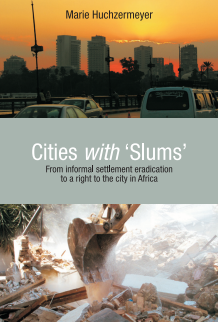 |
| Cities with Slums |
The UN’s Development target to improve the lives of 100 million ‘slum’ dwellers has been inappropriately communicated as a target to free cities of slums. Cities with ‘Slums’: From Informal Settlement Eradication to a Right To The City In Africa traces the proliferation of this misunderstanding across several African countries, and explains how current urban policy, with its heightened focus on urban competitiveness and associated urban policy norms, encourages this interpretation.
Subscribe to:
Comments (Atom)